
Urban heat and climate resilience
Many cities around the world are investing billions to restore tree canopy and urban cooling after decades of vegetation loss. Many established Melbourne suburbs already have much of this natural climate resilience. Good planning should retain and strengthen it — not gradually remove it.
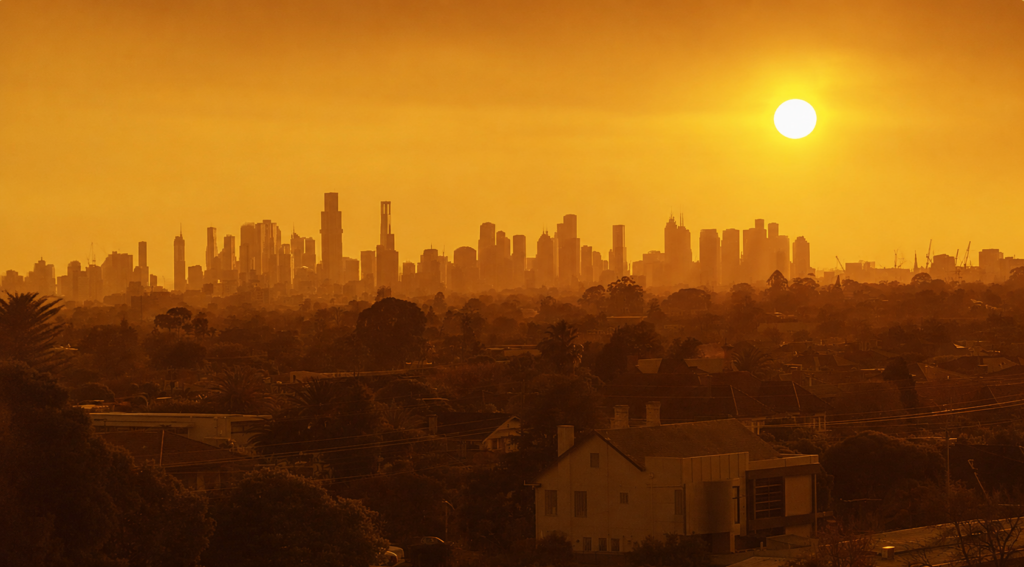
The coolest suburbs in Melbourne are not an accident. They are the product of decades of tree growth and generous garden landscapes.
Melbourne is becoming hotter. The way we plan our suburbs will help determine how well we cope with that future.
The Urban Heat Island Effect means that built-up areas become significantly hotter than surrounding vegetated areas because buildings, roads and paved surfaces absorb and store heat.
Boroondara’s extensive tree canopy and private gardens currently help moderate these effects. The current planning changes reduce many of the landscape features that make this natural cooling possible.
At a glance
- More intensive redevelopment reduces space for mature trees, gardens and deep soil that naturally cool our suburbs.
- Hard surfaces absorb and store heat, while trees and vegetation provide shade and cool the air through evapotranspiration.
- More than half of the vegetation in Melbourne’s inner south-east is on private residential land, making front and back gardens critical to cooling our suburbs.
- Achieving the Government’s 30% canopy target will become increasingly difficult as redevelopment removes existing trees, vegetation and gardens and reduces the space needed to grow the next generation of large canopy trees.
- Little publicly available evidence explains how canopy and garden loss has been modelled or how climate resilience targets will be achieved alongside more intensive redevelopment.
- Air conditioning protects people indoors during extreme heat, but it does not cool neighbourhoods. It transfers heat from buildings to the outdoors, adding waste heat to already hot urban environments.
What is the Urban Heat Island Effect?
The Urban Heat Island Effect occurs when buildings, roads and other hard surfaces absorb and store heat during the day before releasing it slowly at night.
As vegetation is replaced by buildings and paving, suburbs become hotter, particularly during heatwaves.
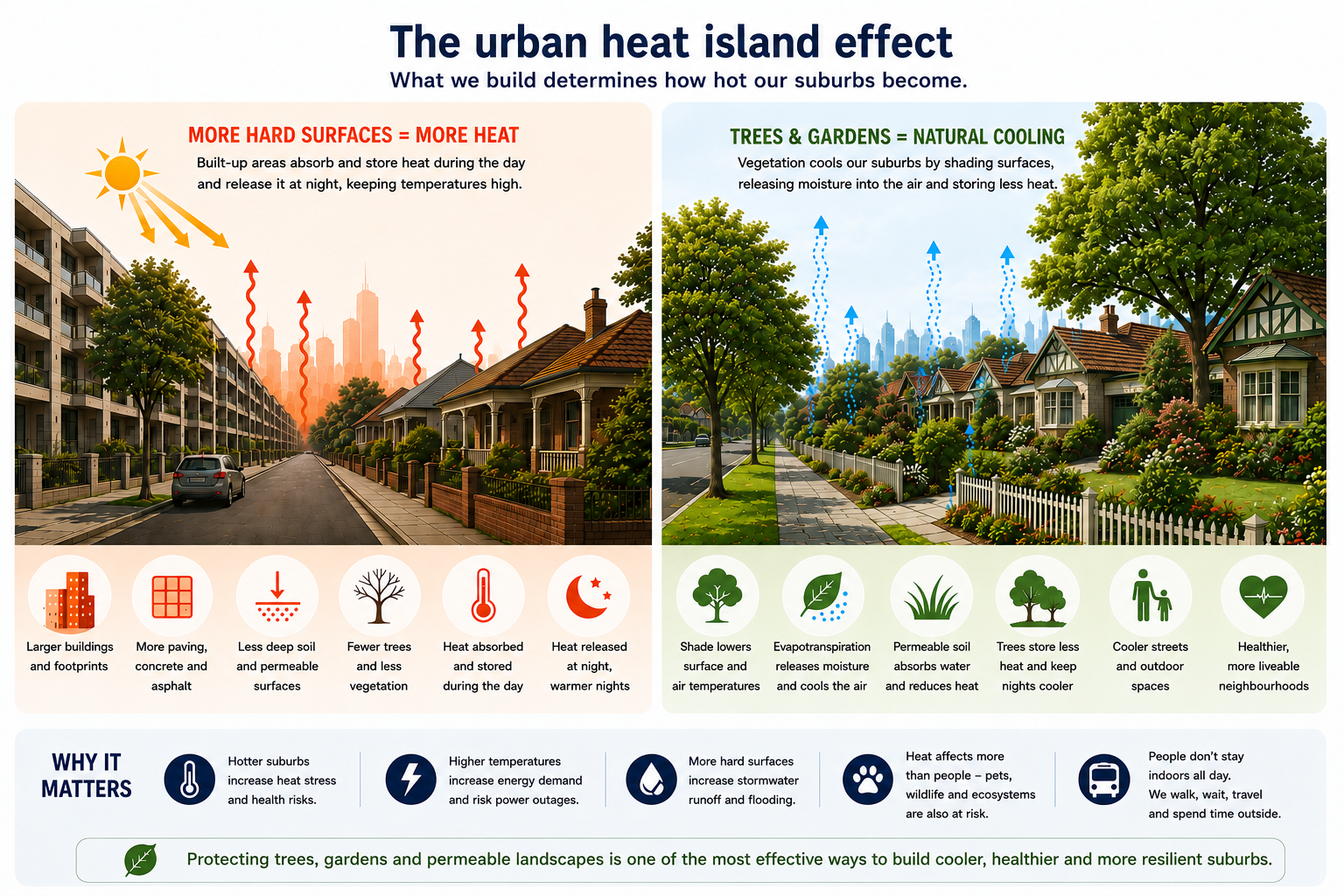
Trees, gardens and permeable landscapes help cool urban environments by providing shade, releasing moisture into the air through evapotranspiration, and reducing the amount of heat stored in the built environment.
Gardens and mature trees are natural cooling infrastructure
Melbourne’s cooling infrastructure extends far beyond parks and street trees.
Private gardens, mature trees, shrubs and permeable landscapes together form an extensive natural cooling network that helps moderate temperatures across established suburbs.
Private gardens are essential green infrastructure
In Melbourne’s inner south-east, which includes Boroondara, more than half of all vegetation occurs on private residential land. Every front garden, backyard and mature tree contributes to cooling the city.
These spaces also provide habitat for wildlife, contribute to neighbourhood character and support physical and mental wellbeing by creating greener, cooler and more pleasant places to live.
Leafy municipalities such as Boroondara form part of the green lungs of metropolitan Melbourne, providing environmental benefits that extend well beyond individual property boundaries.
This is climate resilience that already exists. Planning for more housing should protect and build on it, not progressively erode it.
Source: Melbourne Vegetation Cover 2018, Inner South East Region, Department of Environment, Land, Water and Planning, Melbourne, Australia. (Read)
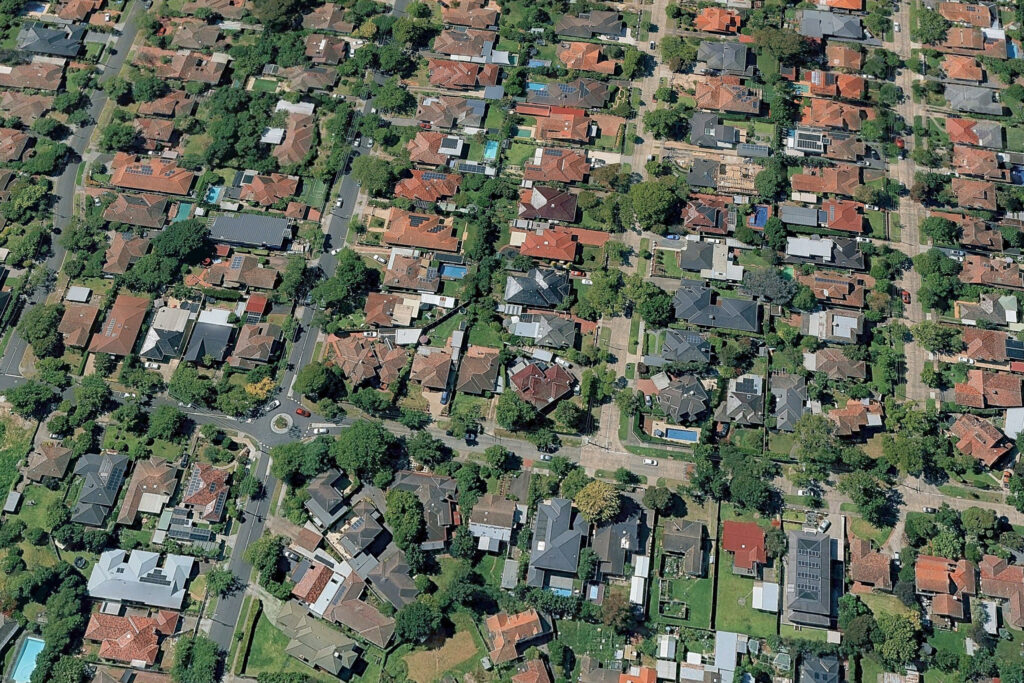
As explained in Concerns → Loss of gardens and tree canopy, the current planning changes reduce the space available for mature trees and gardens through smaller setbacks, increased site coverage and more intensive redevelopment.
While the impact of any single development may appear modest, thousands of similar developments across Melbourne can gradually erode this natural cooling network.
The challenge is not simply planting more trees in the future — it is protecting the gardens, canopy and vegetation that already help keep our suburbs cool today.
More hard surfaces, more heat
Vegetation cools cities. Hard surfaces do the opposite.
Buildings, roads, driveways, concrete and paving absorb large amounts of solar heat during the day contributing to hotter streets. They slowly release it after sunset, keeping neighbourhoods warmer well into the evening. Unlike vegetation, they do not actively cool the surrounding air.
As redevelopment becomes more intensive, residential lots typically contain:
- Larger building footprints.
- More concrete, paving and other hard surfaces.
- Less permeable soil and vegetation.
- Fewer mature trees and less shade.
The result is a gradual shift from landscapes that naturally dissipate heat to built environments that absorb, retain and radiate it.
This contributes to:
- Higher daytime surface temperatures.
- Warmer nights as stored heat is slowly released.
- Hotter footpaths, roads and public spaces.
- Less comfortable outdoor environments during heatwaves.
While buildings may provide shade, they do not provide the same cooling benefits as vegetation. Trees and gardens cool the surrounding air through evapotranspiration, whereas buildings and hard surfaces continue to store and radiate heat long after direct sunlight has passed.
Can canopy targets be achieved?
The internationally recognised 3-30-300 rule recommends a minimum standard for climate-resilient neighbourhoods of 30% tree canopy cover, access to a park within 300 meters, and visibility of at least three trees from every home, school or workplace.
Boroondara — one of Melbourne’s greenest municipalities — does not currently meet the 30% canopy benchmark.
In 2022, tree canopy covered 25.7% of the municipality, and this figure is expected to decline further as vegetation is removed for major infrastructure projects such as the North East Link.
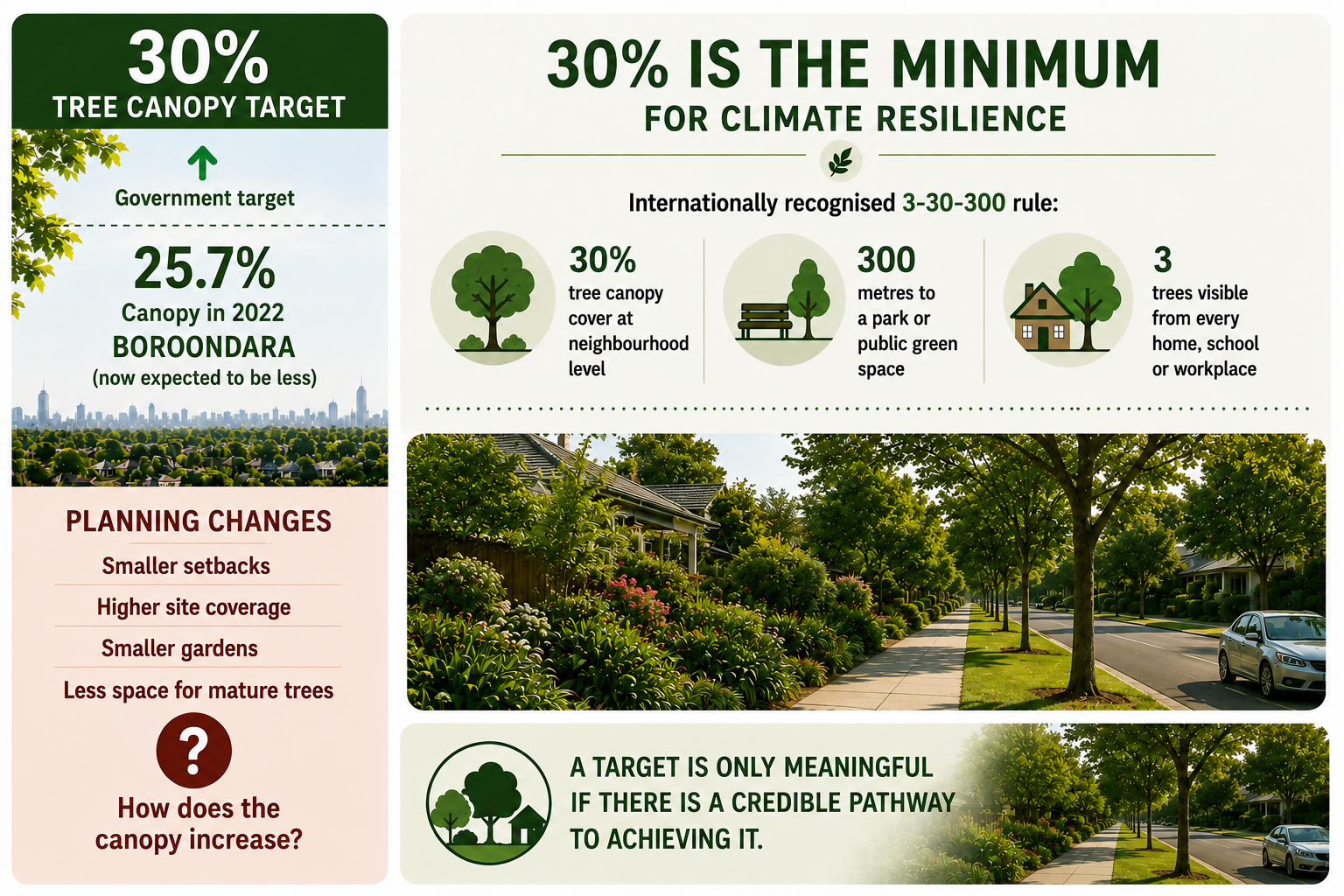
Two questions remain.
- How will canopy targets be achieved if redevelopment progressively removes the private gardens and deep soil where many mature trees currently thrive?
- How will suburbs that already have low canopy cover and limited planting opportunities ever reach the recommended minimum?
These questions become even more important given that more than half of Melbourne’s inner south-east vegetation occurs on private residential land.
Street trees cannot replace private gardens
Street trees will continue to play an important role, but they cannot replace the extensive network of vegetation found across private residential land.
In discussions about increasing residential density, additional street-tree planting is often presented as a way to offset the loss of trees and gardens from private land. But public land cannot simply absorb that loss.
In many streets there is limited room to plant additional large canopy trees, and street trees alone cannot compensate for the cumulative loss of thousands of private gardens.
Achieving higher canopy cover depends on having enough space for large trees to grow, yet the current planning changes reduce that space on private residential land. See Concerns → Loss of gardens and tree canopy.
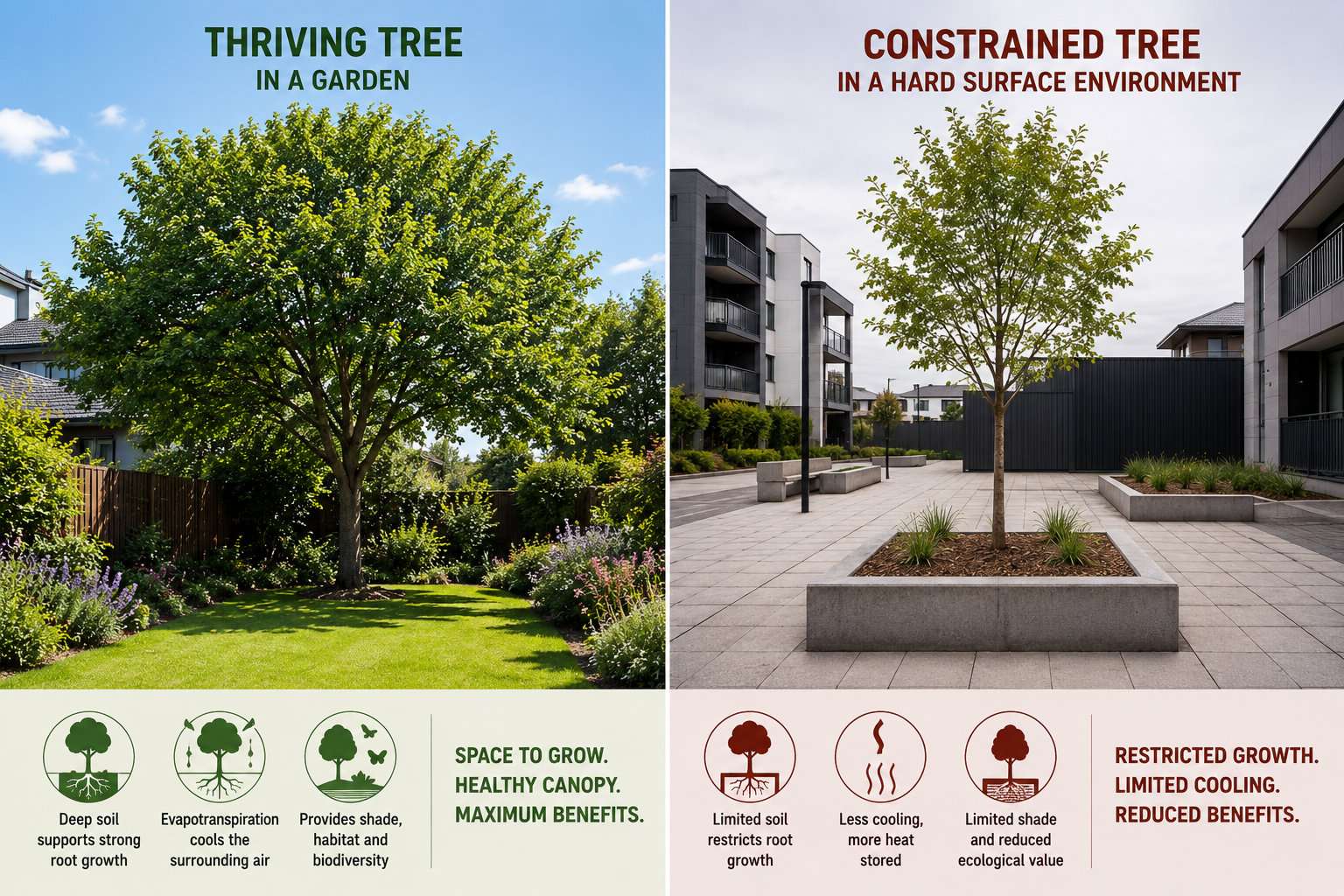
Where is the evidence?
The Government has publicly committed to increasing canopy across Melbourne. However, little publicly available information explains:
- How much existing tree canopy and vegetation is expected to be lost through the Activity Centres Program?
- What modelling has been undertaken to assess that loss?
- What measures will ensure that lost canopy and vegetation are replaced, and how long will replacement canopy take to mature?
- How will the Government achieve its 30% canopy target while permitting more intensive redevelopment across established suburbs?
Without this information, it is difficult for the community to understand how the Government expects its canopy targets to be realised.
A target is only meaningful if there is a credible pathway to achieving it.
Why air conditioning is not enough
Air conditioning is essential for protecting people during extreme heat, but it cannot replace the cooling benefits of trees, gardens and other urban vegetation.
Air conditioning cools buildings. Trees and gardens cool cities. Suburbs and cities are experienced outdoors as well as indoors. Cooling homes is not the same as cooling neighbourhoods. Renewable electricity can reduce emissions. It cannot provide shade, cool a footpath, lower surface temperatures or create habitat for wildlife.
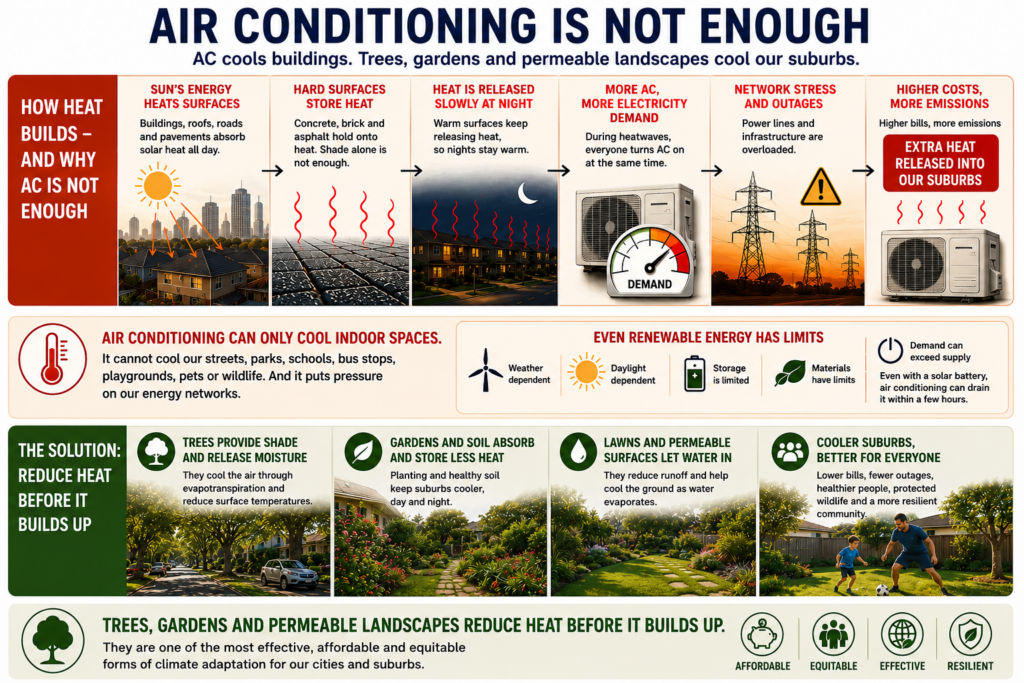
Even with air conditioning, people still need to:
- Walk to public transport, schools and shops.
- Wait at tram stops and bus stops.
- Use parks, playgrounds and sporting facilities.
- Exercise, walk their dogs and spend time outdoors.
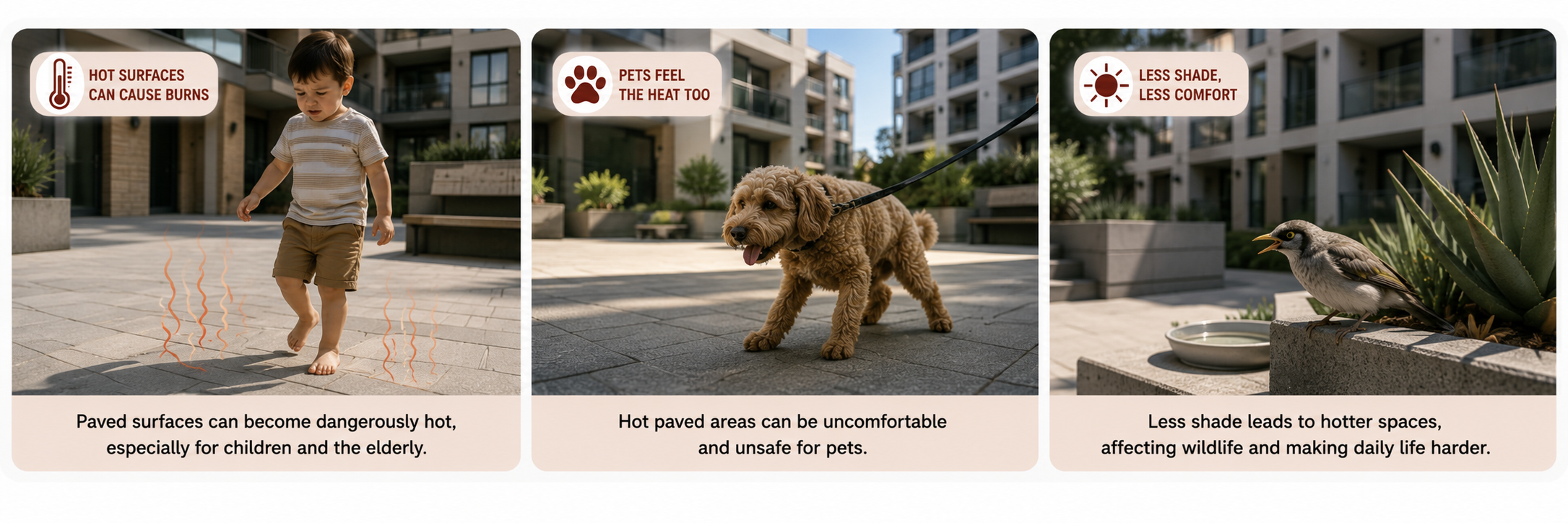
Pets and urban wildlife are also exposed to extreme heat and depend on shade and vegetation to find cooler refuge.
Air conditioners do not eliminate heat; they transfer heat from inside buildings to the outdoors. Outdoor condenser units release that heat into the surrounding air and also generate additional heat as they operate. When many air conditioners are running during hot weather, this waste heat can contribute to higher outdoor temperatures, particularly in densely built-up areas.
Greater reliance on mechanical cooling can also:
- Increase electricity demand during heatwaves.
- Add to household energy costs.
- Release additional waste heat into the surrounding environment.
- Increase pressure on electricity networks during periods of peak demand.
Trees, gardens and permeable landscapes help reduce temperatures before buildings need to be mechanically cooled, making them an essential form of climate adaptation that cools both homes and the neighbourhoods around them.
Why this matters
Urban heat is not simply an environmental issue. It directly affects health, comfort, infrastructure and the long-term liveability of our suburbs.
Higher temperatures increase the risk of heat-related illness, household cooling costs and pressure on electricity, transport and water infrastructure. They can also make parks, playgrounds, streets and other outdoor spaces increasingly uncomfortable or unsafe during extreme heat. Vulnerable people, pets and urban wildlife are particularly exposed.
As climate change increases the frequency and intensity of extreme heat events, protecting the natural cooling provided by trees, gardens and permeable landscapes becomes increasingly important. These same landscapes also support biodiversity by providing habitat and ecological connections for urban wildlife.
What this means for Melbourne
Many established suburbs, including Boroondara, already benefit from extensive tree canopy and private gardens that help moderate summer temperatures.
These natural cooling systems have developed over many decades and cannot be replaced quickly once they are lost.
These suburbs already possess a level of urban greening and climate resilience that numerous overseas cities are now investing heavily to restore after decades of vegetation loss.
In suburbs with lower levels of vegetation, increasing tree canopy and climate resilience is already a significant challenge.
In greener suburbs, the challenge is different: protecting the mature trees and gardens that already provide these benefits while accommodating future growth.
Good planning should aim to increase housing while strengthening urban climate resilience. These goals should reinforce, not undermine, each other, and achieving both requires planning that protects the mature trees, gardens and deep soil that already help keep Melbourne’s suburbs cooler.
As Melbourne becomes hotter, preserving and expanding urban greening will become increasingly important — not simply to meet canopy targets, but to ensure Melbourne’s suburbs remain healthy, comfortable and liveable for future generations.
Explore related topics
These planning issues are closely connected. You may also be interested in:
- Concerns → Loss of gardens and tree canopy
How reduced setbacks and more intensive development leave less space for mature trees, deep soil and meaningful gardens. - Concerns → Biodiversity loss
How gardens and vegetation support wildlife and healthy urban ecosystems. - Concerns → Heritage and neighbourhood character
How mature trees and gardens shape the character of Melbourne’s established suburbs.