Biodiversity loss
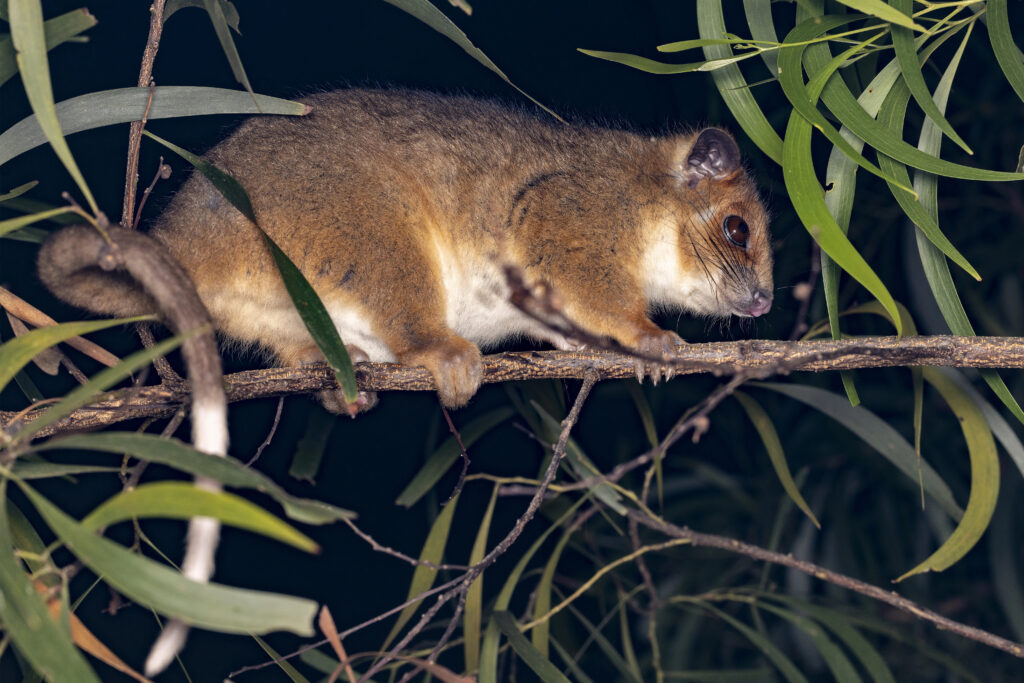
Biodiversity doesn’t begin at the edge of a national park. It begins in ordinary suburban gardens. No single garden supports Melbourne’s biodiversity. Thousands of gardens do. Private gardens, mature trees and connected habitats together support the birds, mammals, insects and other wildlife that make Melbourne’s suburbs unique. Good planning should protect these living systems — not gradually fragment and diminish them.
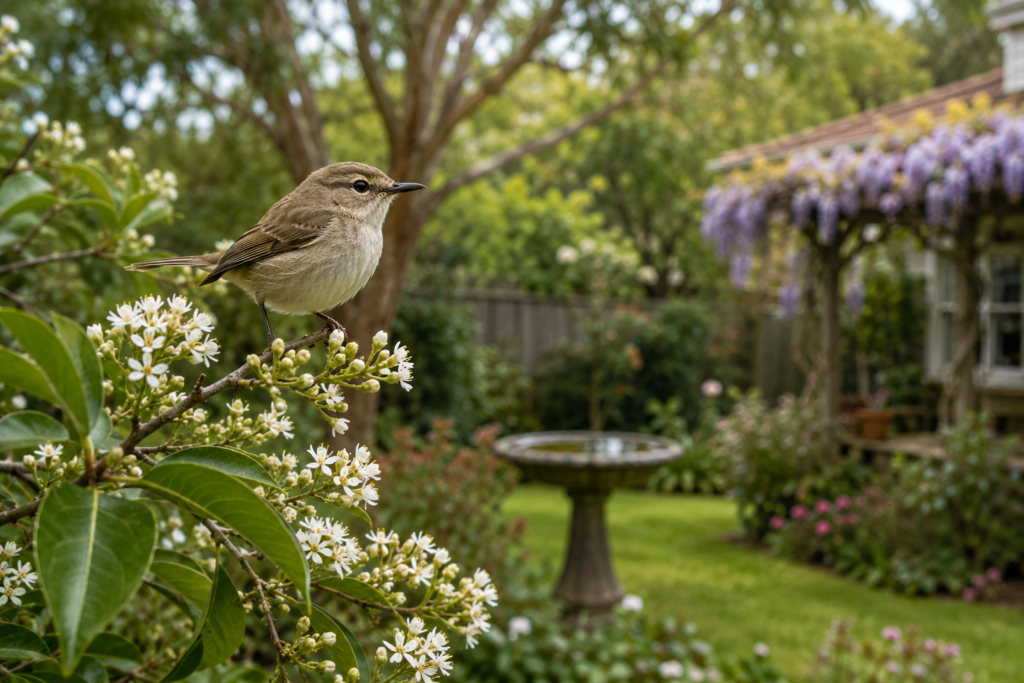
Biodiversity doesn’t only exist in reserves and parks. It exists in ordinary suburban gardens.
Melbourne’s suburbs are part of a broader ecosystem of trees, gardens, waterways and wildlife habitats. Together, these spaces support an extraordinary diversity of plants and animals across the city.
As redevelopment becomes more intensive, the loss and fragmentation of private gardens and vegetation places increasing pressure on the habitats and ecological connections that urban biodiversity depends on.
At a glance
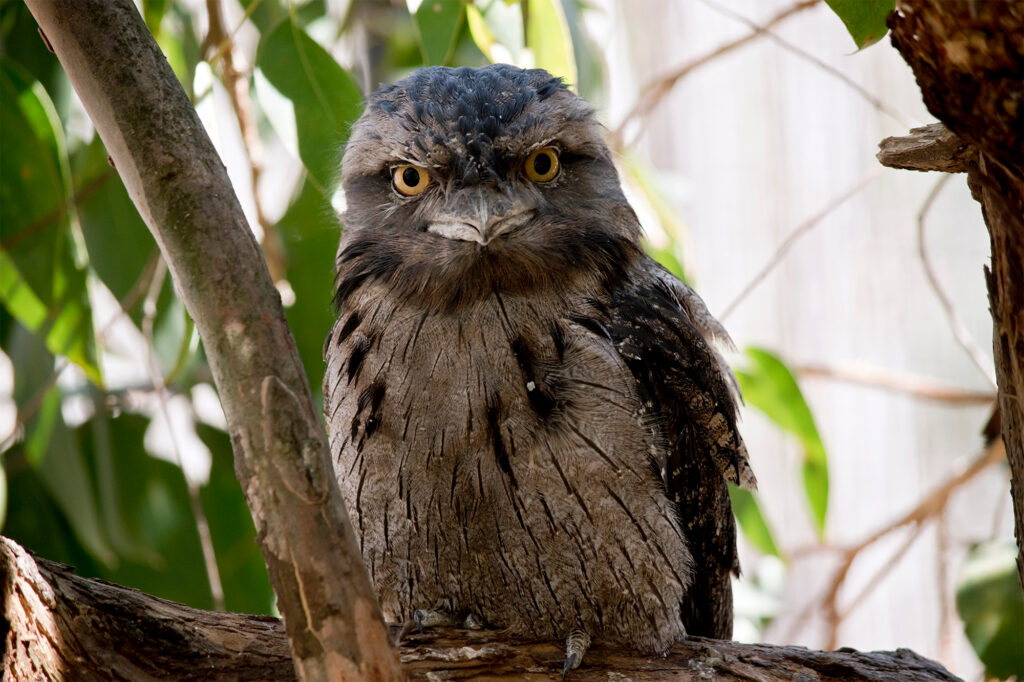
- Urban biodiversity depends on thousands of private gardens, not just parks and reserves.
- Gardens, mature trees, shrubs and under-storey vegetation together provide food, shelter and movement corridors for wildlife.
- As redevelopment becomes more intensive, habitat is gradually lost and fragmented across entire neighbourhoods.
- Daily contact with nature contributes to health, wellbeing and people’s connection to the places they live.
- Protecting biodiversity requires more than planting trees — it depends on preserving connected habitat and healthy urban ecosystems.
A suburban ecosystem
Melbourne’s biodiversity is one of the reasons so many people love living here.
A typical Boroondara garden can support an extraordinary diversity of wildlife.
The illustration below shows just some of the birds, mammals, reptiles, amphibians, insects and soil organisms that may be found in a healthy suburban garden.
Every labelled species in the illustration has been recorded in Boroondara and may be found in suburban gardens.
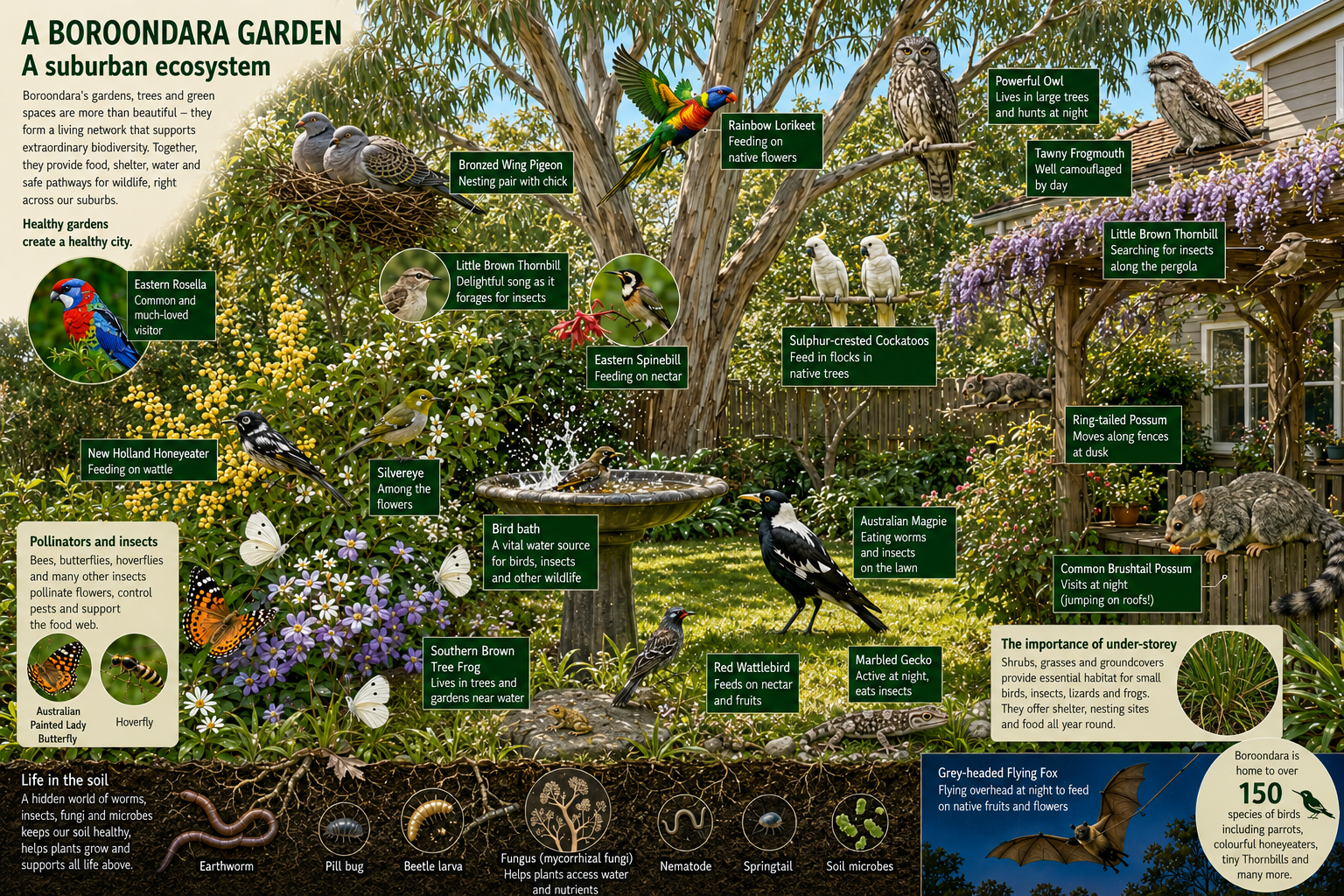
Boroondara’s gardens support a remarkable diversity of wildlife. Mature trees, shrubs, flowering plants, climbers, lawns, ponds and healthy soils together create habitat for birds, mammals, reptiles, frogs, insects and countless other organisms.
Although each individual garden may seem small, collectively they form an interconnected network that supports biodiversity across the municipality.
Many of these species depend not on parks alone, but on the thousands of private gardens that link streets, reserves, waterways and bushland. Birds move between flowering trees, pollinators forage from garden to garden, possums travel along canopy and fence lines, and insects, fungi and soil organisms quietly sustain the ecological processes on which the whole system depends.
This diversity is one of the defining characteristics of Boroondara’s leafy suburbs.
It is the product of decades of vegetation growth and many residents’ love of gardens, and cannot be recreated quickly once lost.
Loss and fragmentation of habitat in established suburbs
Although each private garden may appear modest in isolation, together they form an extensive network of habitat across Boroondara.
Healthy urban ecosystems depend not simply on isolated parks and reserves, but on this continuous network of trees, gardens, shrubs and other vegetation across both public and private land.
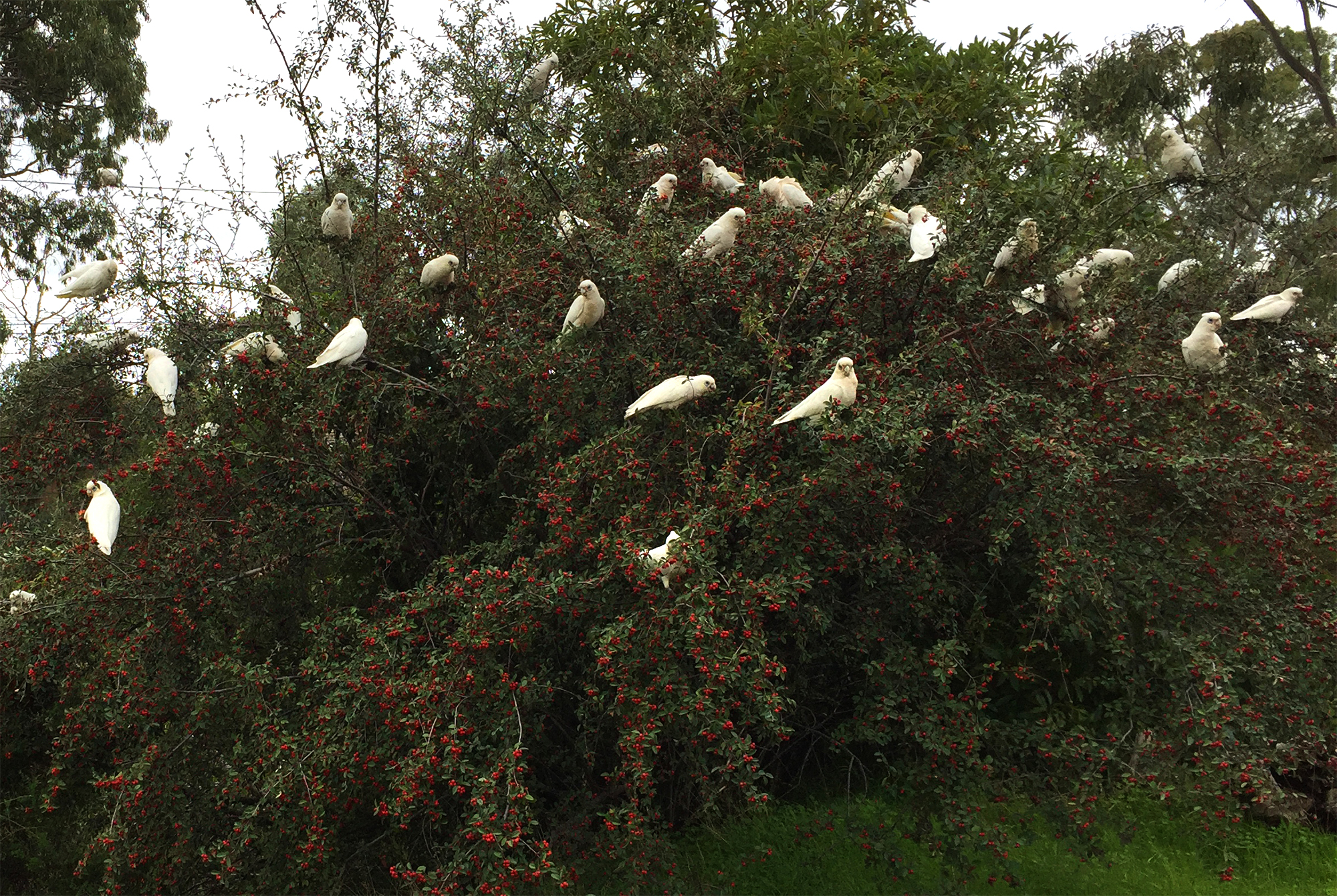
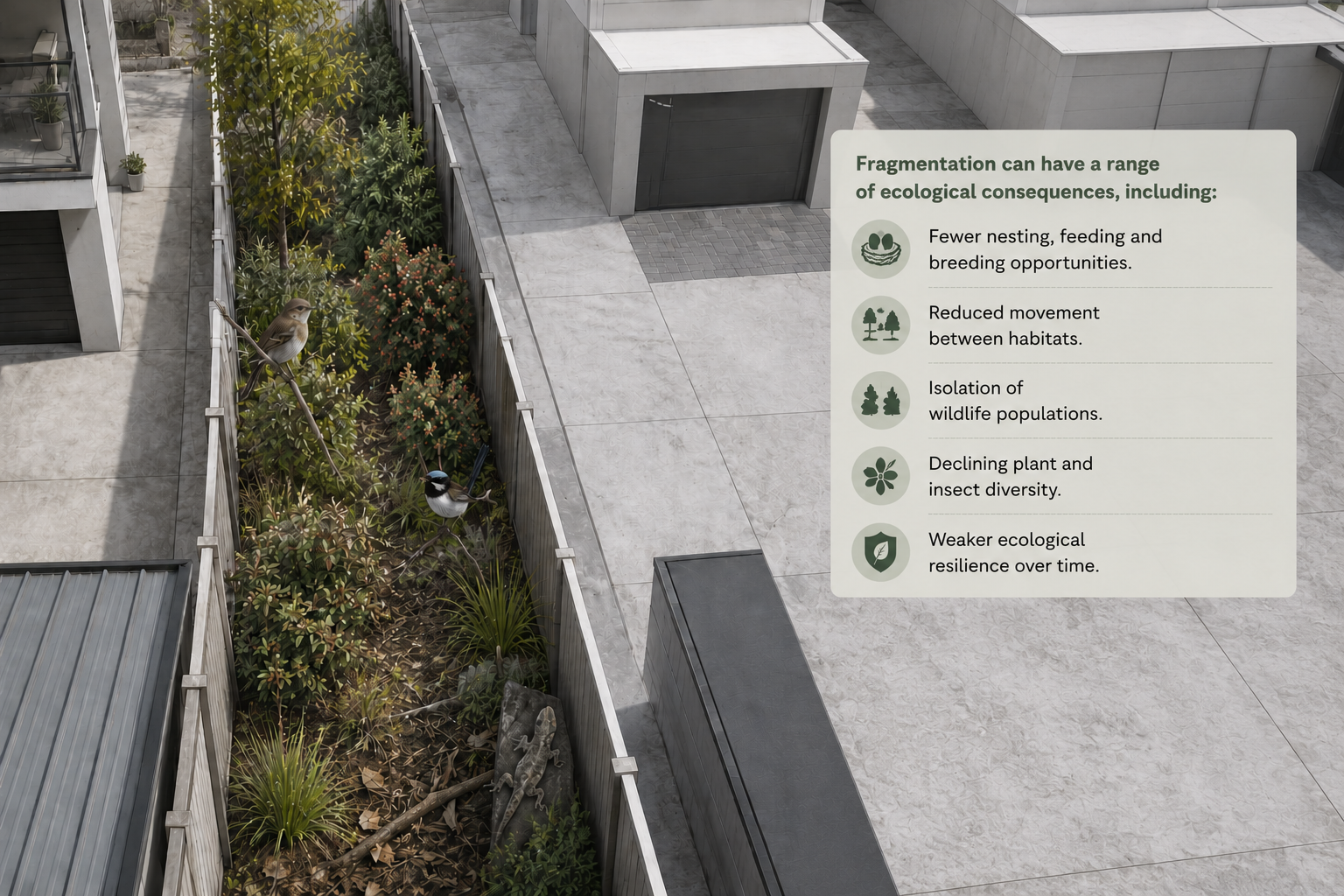
As redevelopment becomes more intensive, mature trees are removed, gardens become smaller and vegetation is progressively replaced by buildings, driveways and other hard surfaces.
The consequences extend well beyond individual properties. As habitat becomes increasingly fragmented, many species find it more difficult to move between food sources, nesting sites and shelter. Ecological connections between private gardens, street trees, parks and waterways are gradually weakened.
See Concerns > Loss of canopy trees and gardens for more information on the planning changes that reduce space for gardens and mature vegetation.
The importance of under-storey vegetation
When people think about biodiversity, they often think about trees.
Yet many of Boroondara’s smallest birds, native bees, butterflies, lizards and countless insects don’t actually live in tree canopies.
They depend on dense shrubs, climbers, grasses, flowering plants and groundcovers rather than the canopy itself.
Species such as the Little Brown Thornbill, Silvereye, Eastern Spinebill and New Holland Honeyeater forage, shelter and nest within this lower layer of vegetation.
Habitat is not simply the presence of vegetation. It is the combination of trees, shrubs, under-storey planting, flowering plants, healthy soils, water and shelter that allows wildlife to survive and reproduce.
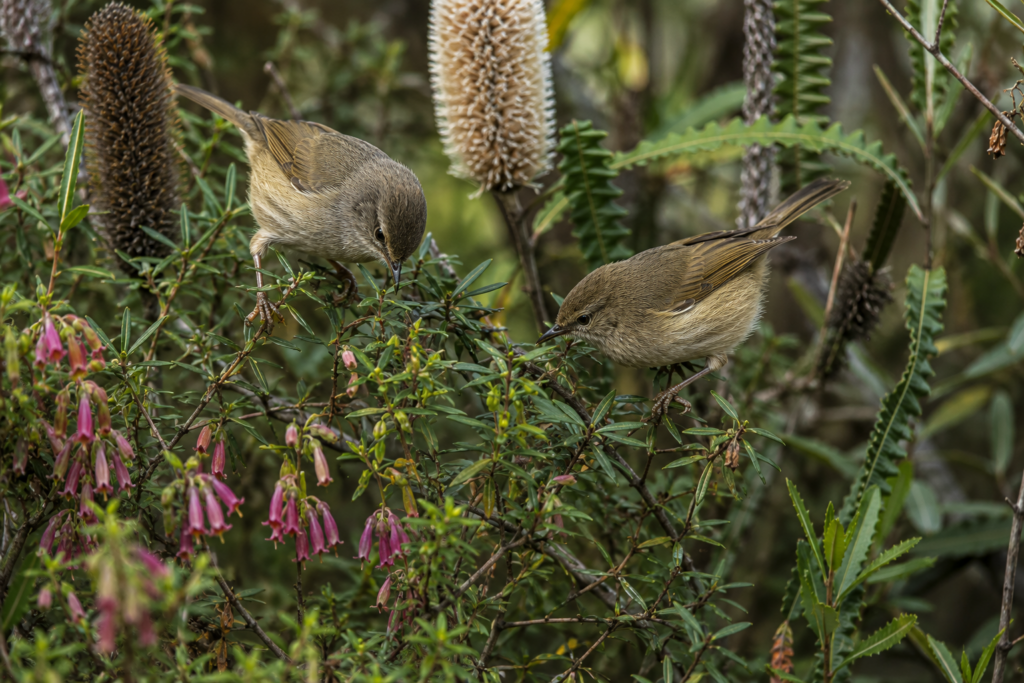
Under-storey planting also supports butterflies, native bees, hoverflies and countless other insects that pollinate plants and provide food for birds, reptiles and frogs.
Healthy leaf litter, logs and soil beneath this vegetation sustain fungi, worms and other organisms that recycle nutrients and maintain soil health.
As gardens become smaller and more intensively landscaped, this structural diversity is often lost. Even where mature trees are retained, simplified planting can significantly reduce the habitat available for many species.
Pressure on waterways and biodiversity corridors
Waterways, such as Gardiners Creek and the Yarra River, may form the backbone of Boroondara’s ecological network, but they cannot function in isolation.
Trees, gardens, parks and street vegetation surrounding these waterways create biodiversity corridors that allow birds, mammals, reptiles, insects and other wildlife to move between habitats, find food and shelter, and maintain healthy populations.
As redevelopment becomes more intensive, these connections can be progressively weakened. The cumulative loss of vegetation on private residential land reduces the continuity of habitat linking waterways and reserves, making it more difficult for many species to move safely through the urban environment.
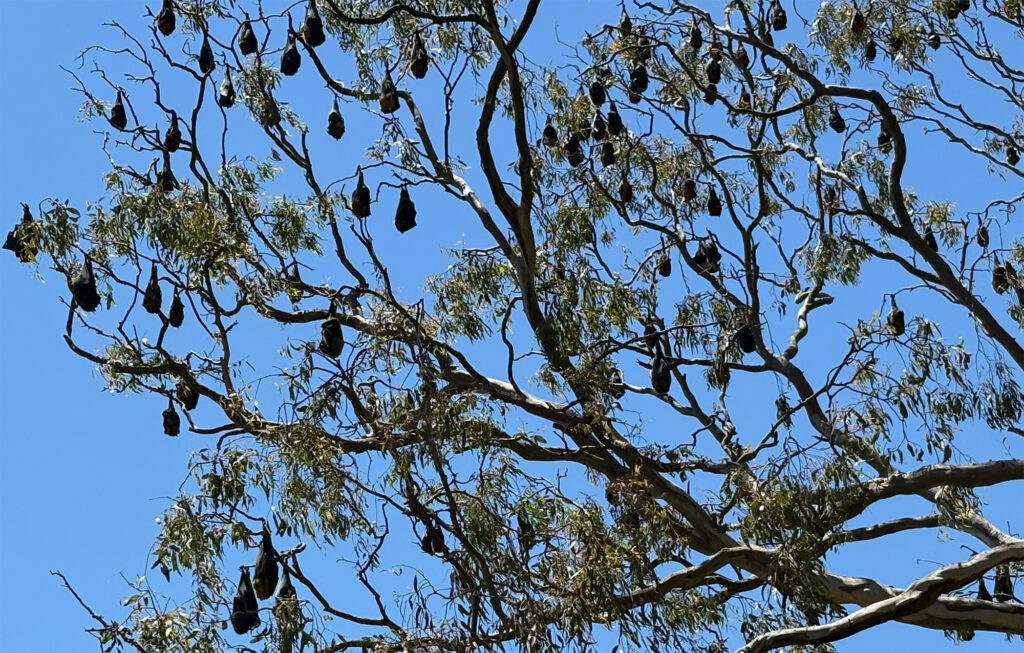
Increased density without appropriate environmental safeguards can increase stormwater runoff, place greater pressure on riparian vegetation, fragment ecological connections and reduce the resilience of urban ecosystems over time.
Because these changes occur gradually across many properties, their impacts accumulate. Protecting biodiversity therefore requires more than conserving waterways themselves.
It also depends on maintaining the surrounding network of trees, gardens and vegetation that supports the movement of wildlife throughout the municipality.
Protecting these ecosystems also depends on careful assessment of stormwater, drainage and other environmental risks during the planning process. See Concerns → Environmental Assessment and Risks.
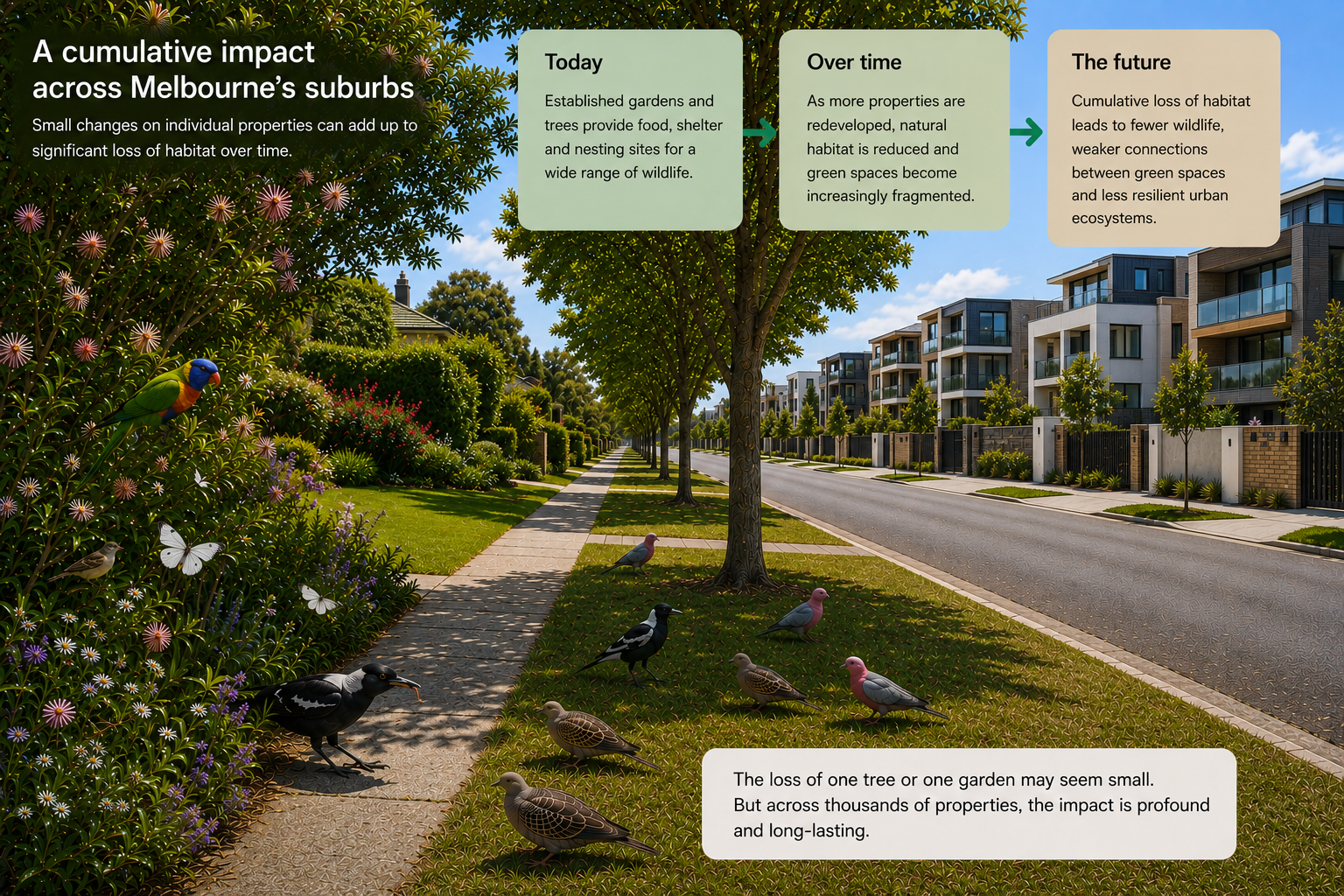
A cumulative impact across Melbourne’s suburbs
The loss of habitat associated with a single redevelopment may appear modest.
One mature tree may be removed, a garden reduced in size, or a small area of understorey vegetation replaced by buildings and paving. Viewed in isolation, these changes can seem relatively minor.
However, the planning changes apply across many thousands of residential properties.
As redevelopment occurs over many years, the cumulative effect can progressively reduce the habitat available for wildlife across entire suburbs.
Because healthy ecosystems develop over decades, these losses cannot be quickly reversed. Once habitat is fragmented and ecological connections are broken, restoring them is often difficult, slow and, in some cases, impossible.
Why this matters
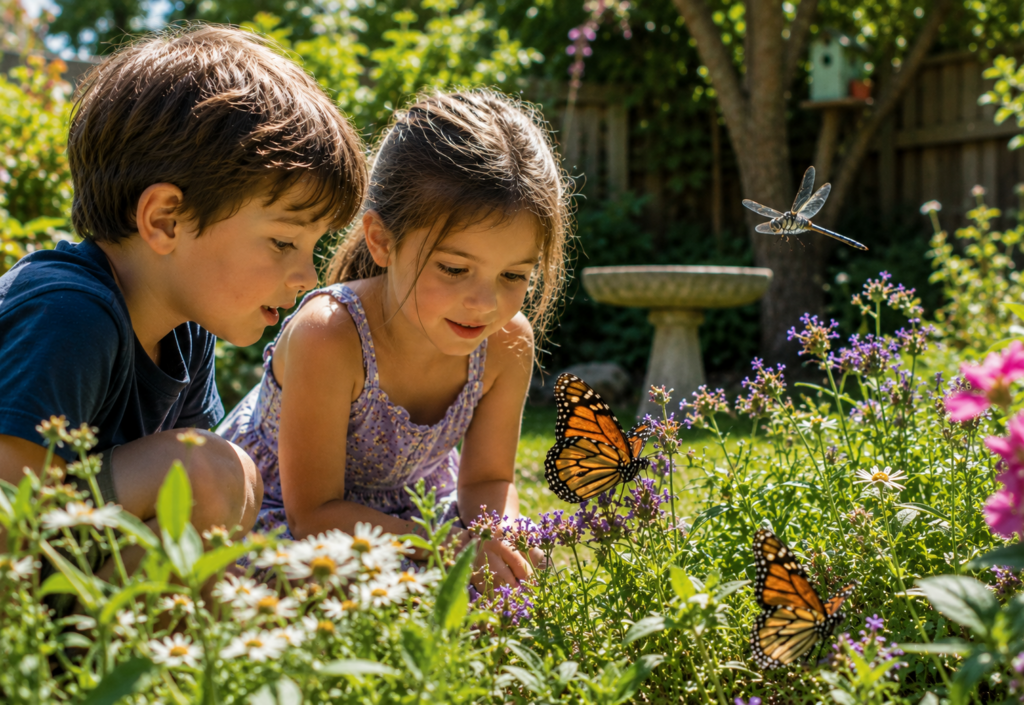
People don’t benefit from biodiversity only when they visit national parks. They experience it every day through birdsong, butterflies, flowering gardens and wildlife in their own neighbourhoods.
Biodiversity is not just an environmental concern — it is fundamental to the health, resilience and liveability of our suburbs. Healthy urban ecosystems provide benefits that support both people and nature every day.
They help to:
- Pollinate plants and support food production.
- Control pests through natural ecological processes.
- Maintain healthy soils and nutrient cycling.
- Improve water quality through healthy soils, vegetation and aquatic ecosystems.
- Support physical health, mental wellbeing and connection with nature.
Healthy ecosystems are generally more resilient because a diversity of species performs different ecological roles, enabling them to better adapt to environmental change and recover from disturbance.
For many people, daily contact with birdsong, butterflies, flowering gardens and other wildlife is an important part of neighbourhood life. Research increasingly shows that access to nature contributes to reduced stress, improved mental health, greater physical activity and stronger community wellbeing. These everyday encounters foster a sense of place, encourage people to spend time outdoors, and help create neighbourhoods that are healthier, calmer and more enjoyable places to live.
Biodiversity also has intrinsic value. Native plants and animals are part of Australia’s natural heritage and have a right to exist irrespective of the benefits they provide to people.
As custodians of the places we live, we have a responsibility to ensure that urban growth does not come at the unnecessary expense of the ecosystems that share our suburbs.
What this means for Melbourne
Melbourne’s biodiversity is shaped not only by its parks and waterways, but also by the thousands of private gardens that connect them.
Protecting these living systems requires planning that recognises vegetation, habitat and ecological connections as essential parts of the urban environment.
Without stronger protections and a more balanced approach to planning, Melbourne risks becoming a denser but significantly less green and biodiverse city. The gradual loss and fragmentation of habitat will affect not only wildlife, but also the health, resilience and liveability of the communities that depend upon it.
As Melbourne continues to grow, protecting biodiversity is not simply about conserving nature.
It is about ensuring that future generations inherit suburbs where people and wildlife can continue to thrive together.
Explore related topics
These planning issues are closely connected. You may also be interested in:
- Concerns → Loss of gardens and tree canopy
Why private gardens, mature trees and deep soil are essential habitat for urban wildlife. - Concerns → Urban heat and climate resilience
How vegetation protects both biodiversity and Melbourne’s climate resilience. - Concerns → Heritage and neighbourhood character
How gardens, trees and landscape settings help define Melbourne’s distinctive suburbs.