
Place-Based Planning
Growth shaped by place, not imposed through blanket planning rules.
Principle
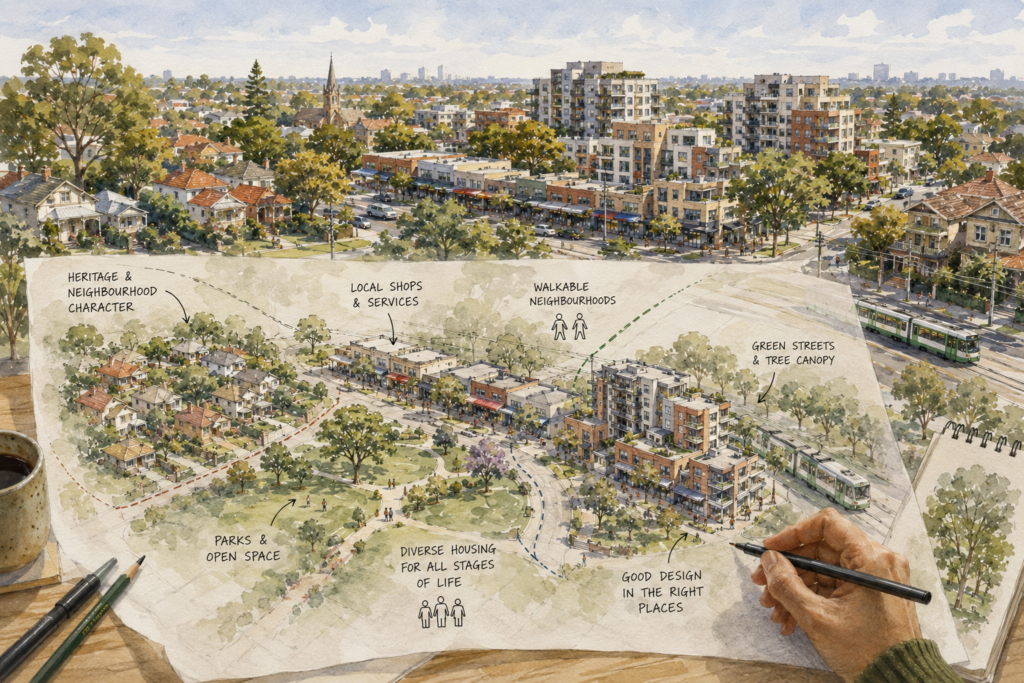
Planning should respond to local context, infrastructure, environmental conditions and the way neighbourhoods actually function.
Why it matters
Melbourne’s suburbs are not interchangeable. They differ in character, transport, services, landscape, heritage, infrastructure capacity and housing needs.
Applying the same development settings across very different places can produce poor outcomes, weaken community trust and prioritise dwelling yield over liveability.
What place-based planning requires
- A stronger role for councils and communities in shaping local outcomes.
- Planning based on how places function, not simply maximising dwelling yield.
- Growth that supports communities as places to live, not just sites for uplift.
- Integrated planning that considers housing, infrastructure, landscape, heritage and environmental outcomes together.
- A diversity of housing for different households and life stages.
- Retention of neighbourhood character, tree canopy and local amenity.
- Planning that responds to the unique character and needs of each neighbourhood, not one-size-fits-all controls.
Boroondara can accommodate more housing without treating every neighbourhood as though it were the same.