
Community and Council locked out
Planning decisions have increasingly been taken away from local communities and concentrated in the hands of the State Government. Councils have lost the ability to shape development in their own municipalities, while residents have few, if any, opportunities to influence decisions that affect their homes, streets and neighbourhoods. Faster planning should not come at the expense of transparency, accountability and democratic participation.
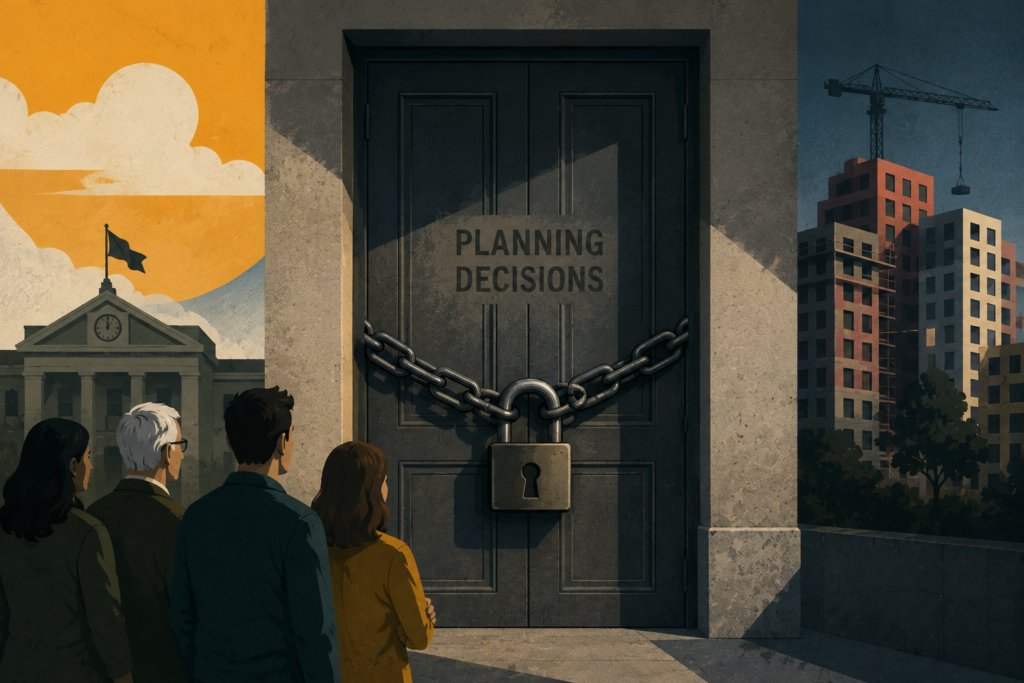
Who decides what gets built next door to you? Increasingly, it isn’t your local council.
Planning has traditionally balanced the interests of landowners, neighbours, councils and the broader community through transparent decision-making and opportunities for public participation.
Recent planning changes have disrupted that balance.
Across new planning Codes, fast-track approval pathways and legislative changes, decision-making is increasingly centralised at the state level, while opportunities for local discretion, community participation and independent review have been vastly reduced and, in some cases, removed altogether.
This page examines how these changes affect democratic participation in Victoria’s planning system.
At a glance
- Planning decisions are increasingly being made through statewide planning Codes and ministerial approval pathways rather than local assessment.
- Councils have less discretion, and sometimes none, to respond to local circumstances, even where developments significantly affect their communities.
- Residents have few, if any, opportunities to influence planning decisions through notification, objections or independent review.
- Decision-making power has been centralised, while local accountability and public participation have been vastly reduced.
- The debate is not whether Melbourne should grow, but who should make the decisions that shape local neighbourhoods.
Reduced notice, objection and appeal rights
Many of the planning issues that residents have traditionally expected councils to assess are no longer open to meaningful community influence.
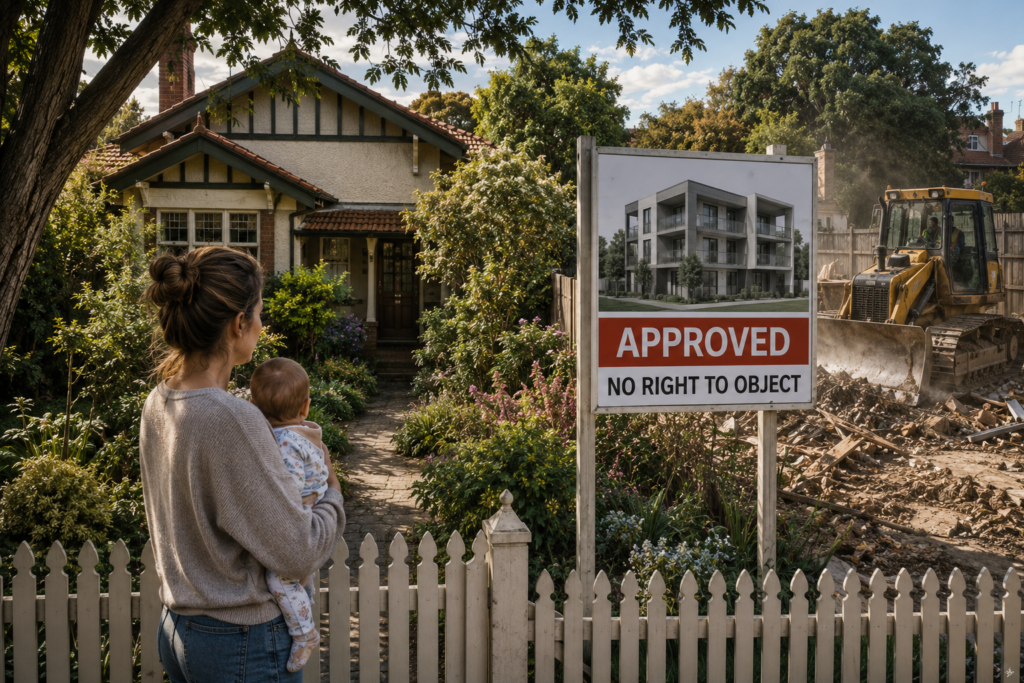
The practical effect of deemed-to-comply pathways is that many of the issues residents have traditionally objected to including matters such as building height, setbacks, overlooking, overshadowing and neighbourhood character are no longer open to meaningful influence where the applicable standards are deemed to be met.
Under the Mid-Rise Code (4—6 storeys), the building heights and front, side and rear setbacks established through the planning controls are similarly not open to public objection at the permit stage.
Across the various planning changes:
- Residents may not be notified of nearby developments.
- Opportunities to object are reduced or confined to narrow technical grounds.
- Objections carry little weight where proposals comply with state planning codes.
- Rights to seek an independent review through VCAT are removed or significantly restricted in some pathways.
- Councils have far less discretion, sometimes none at all, to respond to community concerns.
- Many planning decisions are increasingly determined through state-controlled codes or approval pathways before residents become involved.
Rather than participating in decisions about the form of development, communities are increasingly asked to respond to proposals where many of the most significant planning decisions have already been made.
See Government Plans for more information on the Townhouse and Low-Rise Code, Mid-Rise Code, Great Design Fast Track, Future Homes Program, Development Facilitation Program and other planning changes.
Councils sidelined
Local councils possess detailed knowledge of their neighbourhoods, infrastructure, heritage, environmental constraints and community priorities. Traditionally, they have played a central role in both strategic planning and the assessment of development proposals.
The current planning changes have substantially reduced that role. Through state-imposed planning controls, deemed-to-comply codes and ministerial approval pathways, councils are being reduced to administering decisions made elsewhere rather than making planning decisions themselves.
Throughout the Activity Centres Program, the Victorian Government consistently presented councils as active partners in preparing the draft maps, planning controls and neighbourhood strategies.
Many councils have publicly disputed this characterisation, arguing that key decisions were made centrally by the Department of Transport and Planning, with councils having little influence over the final outcomes.
This portrayal reassured residents that councils were helping shape the changes to their neighbourhoods, while obscuring where planning authority actually lay and weakening public accountability.
Under “deemed-to-comply” codes and fast-track processes:
- Councils are required to approve compliant developments.
- Their discretion to assess local context, design quality, neighbourhood character and residential amenity is significantly reduced, sometimes removed altogether.
- Strategic local planning work is overridden by state-imposed controls.
This shifts councils from decision-makers to administrative processors of applications.
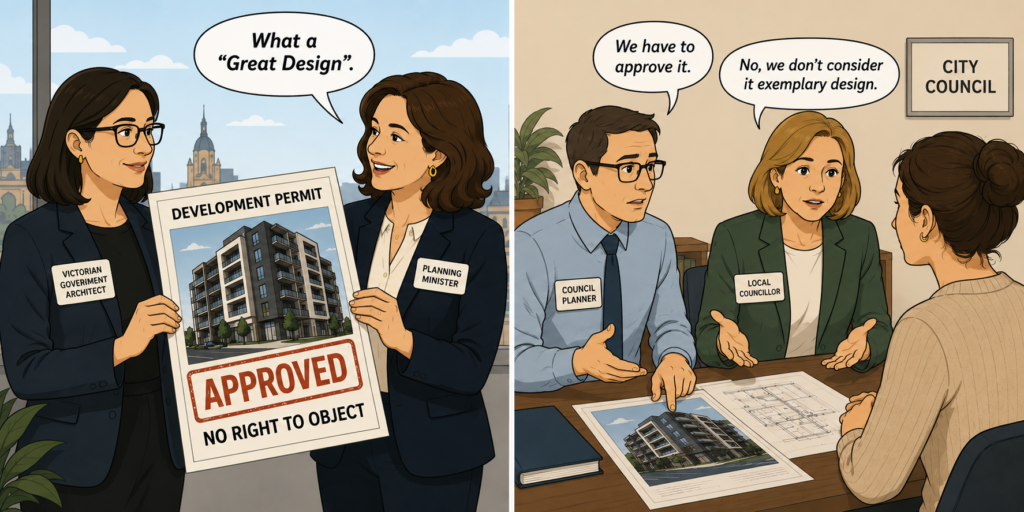
By stripping local governments of their traditional assessment and decision-making responsibilities, the state government is removing the crucial layer of local knowledge.
Communities lose their agency, and decisions that fundamentally reshape streets and neighbourhoods are shifted away from local accountability to centralised, bureaucratic control behind closed doors.
See Government plans → Great Design Fast Track for more information.
Centralisation of power
As councils lose planning powers, more authority is concentrated in the hands of the Planning Minister.
Through a range of planning changes, the Minister can:
- Approve developments or development pathways directly.
- Amend planning schemes with reduced oversight.
- Expand fast-track pathways across the system.
- Call in or exempt certain developments from normal planning processes.
- Establish state-wide planning controls that override local planning policies.
Together, these planning changes concentrate decision-making at the state level, reducing local oversight and removing many important planning decisions from meaningful public scrutiny.
As decisions are increasingly made centrally, communities have lost opportunities to influence the planning outcomes that shape their neighbourhoods

When more planning decisions are concentrated in the hands of fewer decision-makers, transparency and independent oversight become even more important. Investigations such as IBAC’s Operation Sandon show why strong safeguards against improper influence matter.
Speed over scrutiny
The Victorian Government has consistently justified these planning changes as necessary to accelerate housing delivery. It argues that deemed-to-comply planning rules provide greater certainty for applicants and reduce approval times.
Removing safeguards may speed up approvals, but it also removes opportunities for councils, communities and independent review to respond to local circumstances and improve planning outcomes.
Independent assessment, public participation and local council scrutiny help identify problems, improve design and ensure development responds to local conditions. Removing these safeguards increases the risk of poorer planning outcomes over time.
This acceleration of the planning process is achieved by:
- Streamlining or removing consultation processes.
- Limiting independent review mechanisms.
- Reducing checks and balances in decision-making.
The result is a planning system in which speed and certainty increasingly take precedence over participation, transparency and local accountability.
Is faster planning the main solution? The Victorian Government argues that faster planning approvals are needed to increase housing supply. However, planning approval is only one stage in the housing delivery process. Large numbers of approved dwellings remain unbuilt, while Australian research consistently identifies construction costs, finance, labour availability, developer behaviour and market conditions as major influences on whether approved housing is ultimately delivered. See Concerns → Is planning the barrier? for a discussion of the evidence.
Why this matters
Planning decisions determine what is built next door, what your street looks like and how your neighbourhood changes over time.
Removing local council and community input means:
- Local knowledge is not reflected in decisions.
- Residents have lost much of their ability to influence changes that directly affect them.
- Trust in the planning system is eroded.
Democratic planning is not about preventing change. It is about ensuring decisions are transparent, informed, accountable and open to public scrutiny before communities are permanently affected.
What this means for Victoria
The cumulative effect of these planning changes is a more centralised planning system with substantially less local decision-making and public participation.
Communities have lost much of their ability to influence the planning decisions that shape their neighbourhoods, while authority has been concentrated at the state level.
This raises a fundamental question: who is planning for Victoria’s future and whose voices are being heard?
The result is a planning system in which faster approvals increasingly come at the expense of public participation, independent scrutiny and local decision-making.
Explore related topics
These planning issues are closely connected. You may also be interested in:
- Concerns → Community consultation and engagement
Were communities genuinely consulted before these planning changes were introduced? - Government Plans
How planning codes, fast-track pathways and legislative changes reduce local decision-making. - Concerns → What are the alternatives?
Was this really the only way to accommodate Melbourne’s future housing needs? - Concerns → Is planning the barrier?
Is faster planning really the main solution to Victoria’s housing shortage?