
Community consultation and engagement
Consultation is only meaningful if people know they are affected, understand what is being proposed and have a genuine opportunity to influence decisions before they are made. Many affected residents were not clearly notified, communities were not given the full picture, and some of the most consequential planning decisions were never open for public consultation.
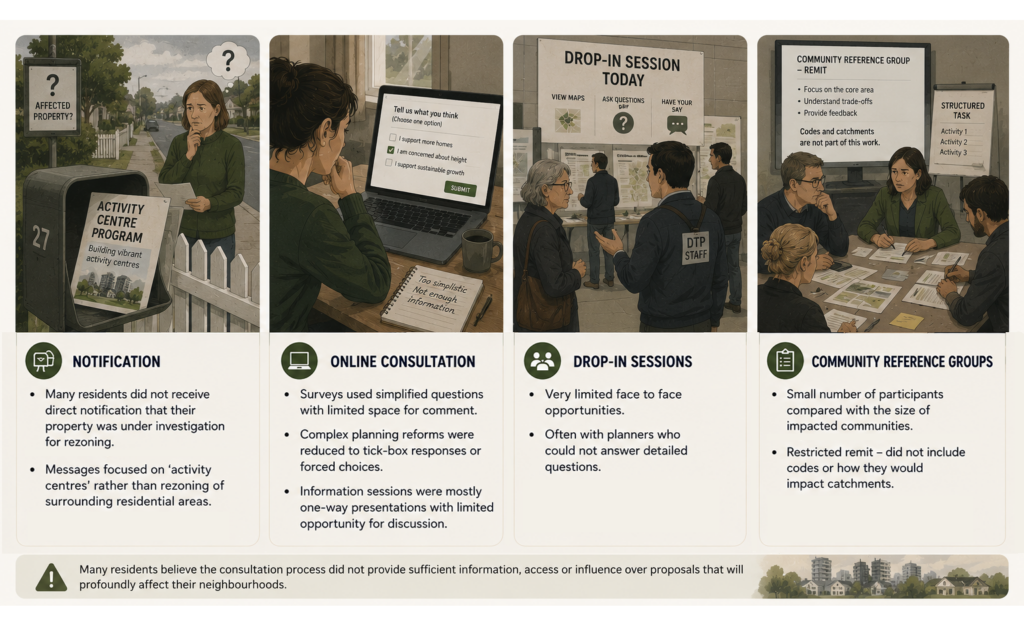
The Victorian Government has repeatedly described consultation on the Activity Centres Program as extensive. But the number of surveys, webinars, information sessions and other engagement activities does not, by itself, demonstrate meaningful consultation. The real test is whether communities were properly informed and able to influence the decisions that mattered.
This page considers four questions:
1. Did affected people know they were affected?
2. Were communities given enough information to understand the proposals?
3. Were communities given genuine opportunities to influence the decisions that mattered?
4. Can the influence of community feedback be seen in the final outcome?
At a glance
- Notification was often unclear, late or failed to reach affected residents at all, leaving many unaware that their own properties and streets were affected.
- The new residential planning Codes were not part of public consultation.
- Consultation focused heavily on activity centre cores while some of the most consequential changes will occur in surrounding residential streets.
- Residents were falsely reassured that neighbourhood character and amenity would continue to be protected, while the planning changes that would weaken those protections were not disclosed during consultation.
- Key elements of the planning model were predetermined, leaving communities with no meaningful role in shaping the fundamental approach.
Notification of affected residents
Did affected people know they were affected? → No.
Meaningful consultation is impossible if affected people do not know they are being consulted.
Effective notification requires two things: information must reach affected residents, and it must clearly tell them what is proposed and that their own property or neighbourhood is affected. The Activity Centres Program fell short on both.
Was the notification clear?
Rather than ensuring all affected households received clear, property-specific notification that their properties were being considered for rezoning, the Government relied heavily on broad promotional material about “activity centres” and generic social media communications.
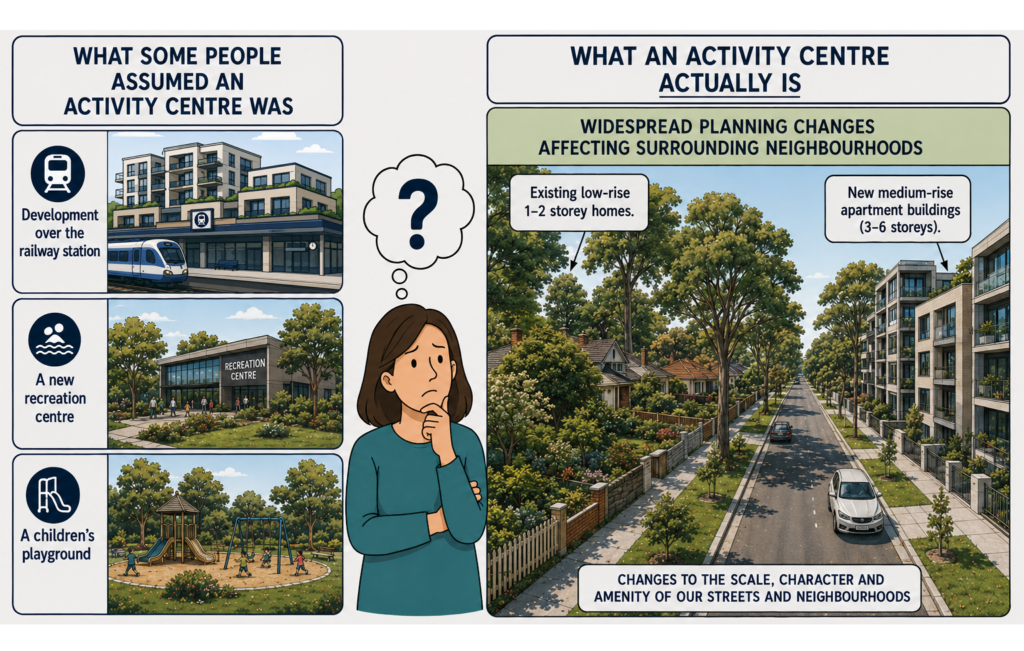
The term “activity centre” itself created confusion. Many residents assumed it referred to development around a railway station or shopping strip, a new recreation centre or even a children’s playground, not widespread planning changes extending into surrounding residential streets.
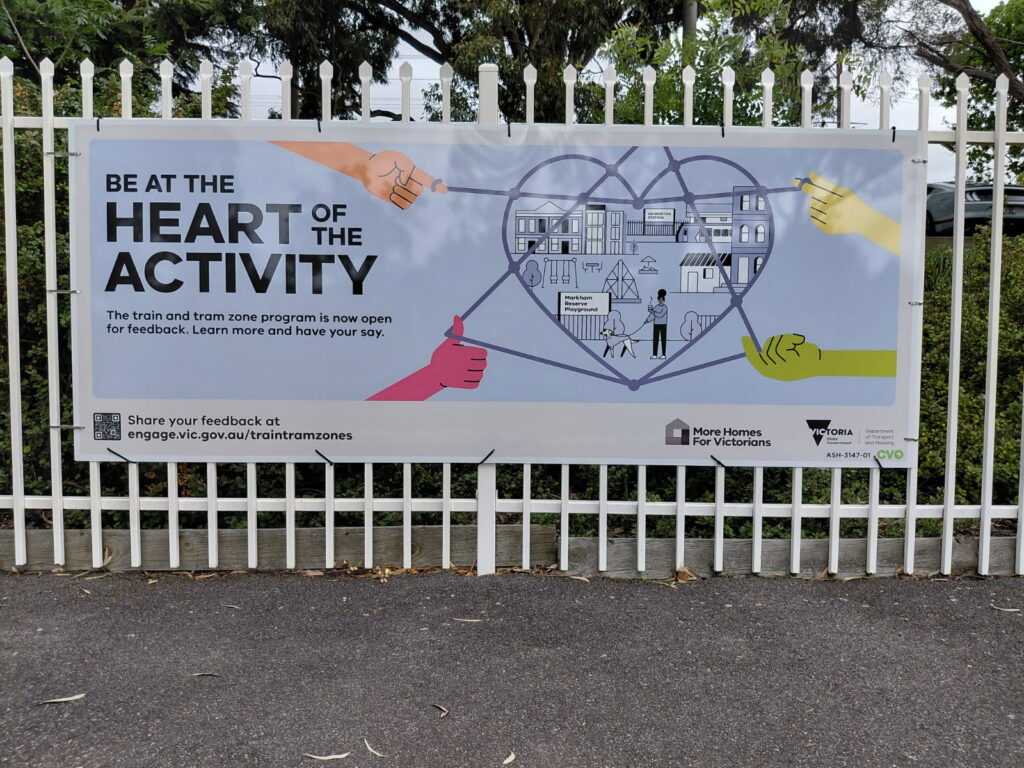
Promotional postcards, newsletters and posters could therefore be easily mistaken for general government information or marketing rather than notification that the recipient’s own property and neighbourhood were affected.
Broad promotional reach is not a substitute for clear, direct notification. Generic social media posts may reach thousands of people without telling affected residents that planning controls on their own property and street are changing, what those changes involve or how they may be affected. Raw reach figures also reveal nothing about who the campaign was intended to reach, who actually saw it or whether it reached the communities directly affected.
The Government was capable of providing direct, property-specific notification when it chose to do so. DTP sent letters to the primary addresses of absentee landowners whose properties were within activity centre boundaries. Yet residents living within the same affected areas were not provided with equivalent direct notification clearly explaining that their own property was affected and what this meant.
If affected absentee landowners could be identified and contacted directly, why was the same approach not used for residents?
Notification did not reach residents in time
Late notification was also a recurring problem. At different stages of the Activity Centres Program, residents received information only after consultation activities had already taken place. During Phase 2 consultation for Tranche 1 activity centres affecting Boroondara residents — including Auburn-Hawthorn, Kew and the Glen Waverley line activity centres — some notification postcards arrived after the scheduled online information sessions had already been held.
The most serious notification failure occurred during Phase 1 consultation for the 25 Tranche 2 Activity Centres, including Ashburton and Riversdale-Willison, where many residents reported receiving no letterbox notification that their properties were within planning investigation areas.
BCG and Boroondara Council subsequently undertook their own notification efforts to alert affected residents and encourage participation before consultation closed.
Even if the Government newsletters had been delivered according to DTP’s intended timetable — and they weren’t — much of the consultation would already have occurred. Residents would already have missed the online information session and one of only two local drop-in sessions. The remaining drop-in session was scheduled for the following day, providing virtually no notice. After that, all opportunities to speak directly with DTP staff, ask questions or seek clarification were over. The survey was the only opportunity remaining to participate, but it provided no opportunity for residents to have their many questions about the proposals answered.
The consequence was that many affected residents had little or no opportunity to participate, undermining the breadth and representativeness of the consultation itself.
Consultation without the full picture
Were communities given enough information to understand the proposals? → No.
During community consultation, residents were repeatedly assured that planning would continue to protect:
- neighbourhood character
- setbacks
- privacy
- trees
- liveability
What residents were never told
- That new residential planning Codes were being developed to govern development within the catchments and other residential areas, but those Codes would not themselves be open for public consultation.
- The Mid-Rise Code and Townhouse and Low-Rise Code would fundamentally change what could be built and how development would be assessed.
- Where a development meets the deemed-to-comply standards, residents have no opportunity to influence those compliant aspects of the development.
- Development would increasingly be assessed against a planned future urban form rather than the existing low-rise neighbourhood.
- The catchment boundaries were not simply lines on a map — they identified residential streets for increased housing density, determining the planning controls that would apply and substantially changing the scale and form of development permitted.
Meaningful consultation requires residents to understand not only where planning changes will apply, but also what those changes are and what they are intended to achieve.
Industry was informed — residents were not
The contrast with the Government’s engagement with the development and planning industry is striking. In presentations to industry audiences, the Department has clearly explained that the Mid-Rise Code requires development to respond to future urban form rather than existing neighbourhood character, that neighbourhood character overlays cannot modify its standards, and that fully compliant applications must be granted a permit.
Residents whose homes and neighbourhoods are directly affected were never given an equivalent explanation. During Activity Centre consultation, residents were shown proposed building heights and catchment boundaries, but given little information about how development within those catchments would ultimately be assessed or how fundamentally the planning framework would change.
The fact that the Mid-Rise Code was still being developed does not resolve the consultation problem. It means communities were being asked to comment on the future of their neighbourhoods before they could be shown the planning rules that would ultimately shape them.
Since the Codes were introduced, the Government has continued to educate industry about how the new planning system operates. Yet there has been no equivalent effort to explain the changes directly to affected residents — not even systematic direct notification that planning controls applying to their own properties have changed.
Consultation focused on activity centres — not the surrounding residential streets
Were communities given genuine opportunities to influence the decisions that mattered? → No.
Much of the consultation focused on activity centre cores, where the highest buildings are planned, along with public spaces, parks, playgrounds and other local features.
Yet for many residents, the most consequential changes were in the surrounding residential streets, where inner and outer catchments would permit 3–6 storey development.
The existence of these residential catchments was treated as a given. Communities were not asked whether this model should apply, whether surrounding residential streets should be included, or how far redevelopment should extend into established neighbourhoods.
Nor were the new planning zones and residential building Codes that would ultimately govern development within the catchments open for public consultation.
Residents could provide feedback within the framework the Government had established, but they were given little opportunity to influence the fundamental planning model itself.
See Government plans → Townhouse and Low-Rise Code and Mid-Rise Code.
Limited opportunities for meaningful engagement
Most consultation occurred through online surveys, webinars and information sessions, supported by a small number of drop-in sessions. Community Reference Groups (CRGs) involved relatively few participants and operated within a limited scope.
Community Reference Groups (CRG)
CRGs focused primarily on activity centre cores, public spaces and broad urban design themes such as movement, safety, infrastructure and open space. Participants were asked how more housing could be delivered while protecting the qualities that made their area unique.
Participants were told that new residential planning Codes were being developed and were reassured that they would protect liveability and neighbourhood amenity. However, they were given no detail about the controls being developed or how these would change development within surrounding residential streets.
A fundamental contradiction in the consultation
Residents were asked how more housing could be accommodated while protecting what made their neighbourhoods unique. Yet they were not given the detail of the new planning Codes — the very controls that would determine whether those qualities could actually be protected.
The contradiction is fundamental. Residents were asked to identify what made their neighbourhoods unique and what they wanted protected, yet the new Codes were being designed to facilitate substantially greater housing density and a transformed future urban form. In doing so, they allow changes to building height, setbacks, site coverage, gardens, tree canopy, privacy and neighbourhood character — many of the very qualities residents identified as important and wished to protect.
Residents were therefore being asked what they valued and wanted protected without being given the information needed to understand that the planning framework itself would place those qualities at risk. That was not a meaningful question for residents to answer.
Online surveys
Online surveys relied heavily on leading statements, binary choices and questions that assumed key elements of the Government’s approach. Complex planning issues were often bundled into simplified checkbox questions, limiting the ability of residents to disagree with underlying assumptions or propose alternatives.
The raw survey results were not publicly released.
Information sessions and drop-in sessions
At online and drop-in sessions, detailed questions about the planning Codes, heritage, tree canopy, climate resilience and environmental sustainability were frequently unanswered or addressed only in broad terms. Questions were often taken “on notice”, with participants reporting that promised responses did not subsequently arrive.
Across these different forms of engagement, residents had little opportunity to question the fundamental planning model or influence the decisions that would shape their neighbourhoods. Consultation took place within the boundaries of a predetermined program, with key parameters already established and communities given no meaningful role in shaping the framework itself.
Did consultation influence the outcome?
Can the influence of community feedback be seen in the final outcome? → No.
The Victorian Government has repeatedly stated that community feedback shaped the Activity Centres Program. The obvious question is: what changed?
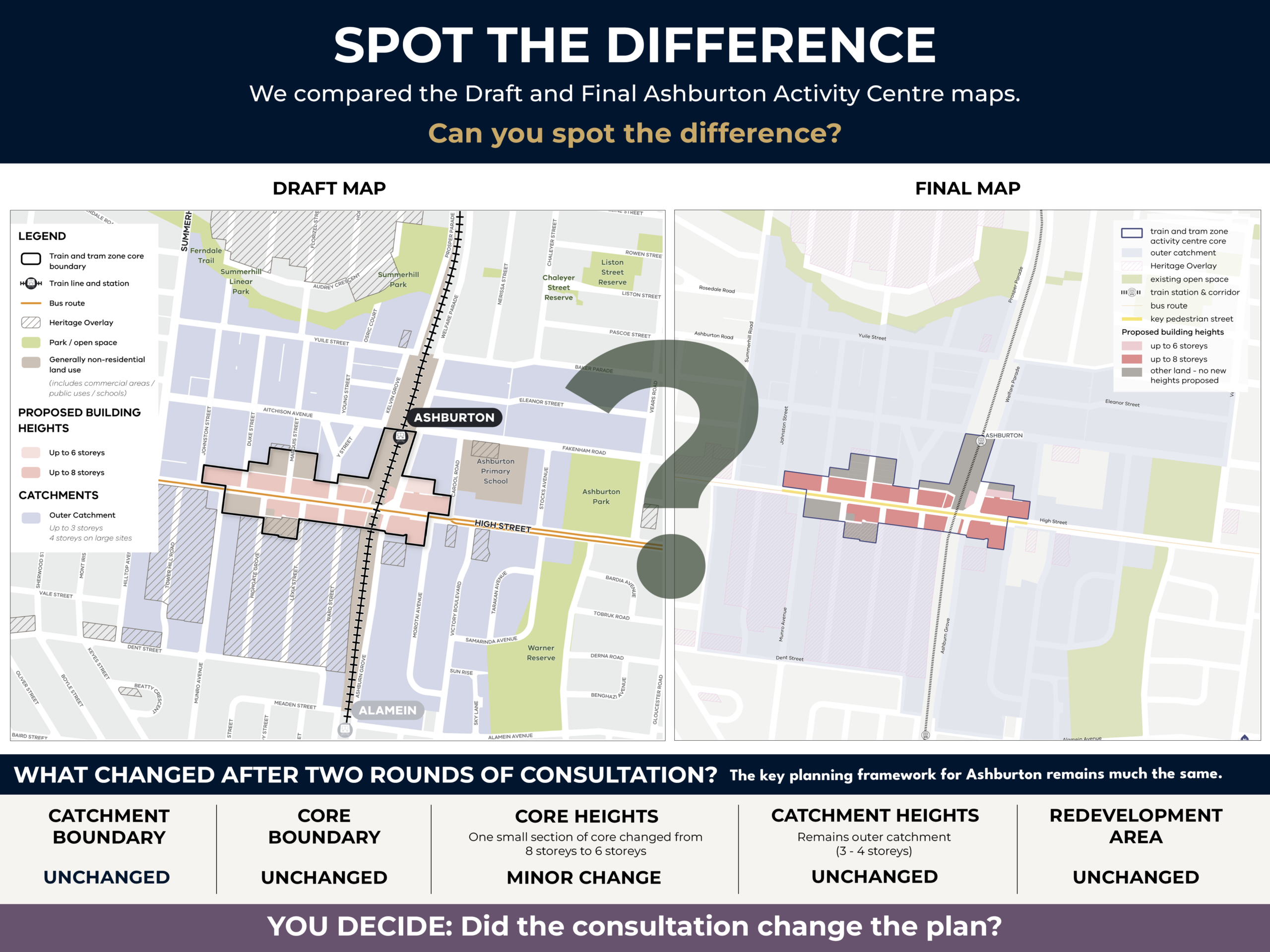
In many centres, the changes made between draft and final plans were confined largely to relatively minor boundary or built-form adjustments. The fundamental model remained: residential catchments, widespread rezoning, substantially increased development capacity and new residential building Codes that had never themselves been open for public consultation.
The Ashburton comparison below illustrates the problem. After two rounds of consultation, the catchment remained essentially unchanged and the principal alteration was a relatively small reduction in height within part of the core.
BCG participated in the consultation process. Based on that experience and the limited changes that followed, we consider much of the consultation performative: communities were invited to comment, but given little opportunity to influence the fundamental decisions shaping their neighbourhoods. Consultation was little more than a box-ticking exercise.
What this means for Melbourne
Meaningful consultation is not measured by social media reach or by the number of surveys, webinars, drop-in sessions or other engagement activities undertaken.
The real test is whether affected communities were properly informed and had a genuine opportunity to influence decisions before they were made.
In the Activity Centres Program, some of the most consequential elements of the planning framework were never open for consultation. Many affected residents were not clearly notified, communities were not given the full picture, and key elements of the planning model had already been decided.
Consultation should help shape decisions. It should not simply seek community views after the direction of travel has already been decided.
When communities cannot see how their participation influenced the outcome, public confidence in both the planning system and future consultation is inevitably diminished.
Explore related topics
These planning issues are closely connected. You may also be interested in:
- Concerns → Community and Council locked out
How the Government’s planning changes strip decision-making power from councils and communities and concentrate it with the Planning Minister. - Concerns → What are the alternatives?
Was this really the only way to accommodate Melbourne’s future housing needs? - Government plans
Overview of the Activity Centres Program, planning Codes and related planning changes.