
Affordable housing
Planning changes alone cannot guarantee affordable housing. The Government is asking communities to accept the transformation of established suburbs on the promise of affordable housing but market-led redevelopment does not guarantee that outcome. Is this genuinely “opening doors” to home ownership for young people and families in areas with expensive land values, or creating new opportunities for high-end property development? Young people deserve real solutions, not false hope.

The Victorian Government argues that increasing housing supply through faster approvals, higher densities and market-driven development will improve housing affordability, particularly for young people and families.
Whether this approach alone can deliver genuinely affordable housing remains the subject of considerable debate, particularly in established high-value suburbs where land prices are already among the highest in Melbourne.
Increasing housing supply and delivering genuinely affordable housing are not necessarily the same thing. This page explores why planning changes alone cannot guarantee affordable housing, particularly in Melbourne’s established high-value suburbs.
At a glance
- Increasing housing supply does not automatically deliver housing that is genuinely affordable to low- and moderate-income households.
- The Activity Centres Program expands development opportunities but does not require developers to provide affordable housing.
- In high-value suburbs such as those in Boroondara, market forces favour higher-priced housing that reflects land values and buyer demand.
- Affordable housing usually requires additional measures such as government investment, subsidies or mandatory inclusionary housing requirements.
- Planning determines what may be built. Market conditions largely determine what is financially viable to build.
How is “affordable housing” defined?
Under the Planning and Environment Act 1987, “affordable housing” has a specific statutory meaning: housing, including social housing, that is appropriate and realistically affordable for very low, low, or moderate-income households and is priced (whether purchased or rented) so those households can meet their other essential living costs. *
It is important to distinguish between housing affordability and affordable housing, as they are not the same thing.
Affordable housing refers to housing that meets the statutory definition under Victorian planning legislation.
Housing affordability refers more broadly to whether housing is affordable across the market and is influenced by many interacting factors, including housing supply and demand, interest rates, taxation settings, construction costs, planning policy, public investment and population growth. Increasing housing supply may improve affordability if it keeps pace with, or exceeds, growth in demand. However, where demand continues to outstrip new housing supply, affordability pressures may persist despite substantial levels of construction.
* The income thresholds for these household groups are updated periodically by Order in Council. See Resources → Official government information → Other for the current thresholds.
More housing, but not necessarily more affordable housing
The Activity Centres Program does not require developers to deliver a single dwelling that meets Victoria’s statutory definition of affordable housing.
Increasing housing supply is an important part of improving housing outcomes. However, whether additional housing improves affordability depends on a range of broader economic and market factors.
The relationship between planning changes, market forces and housing affordability can be summarised as follows:
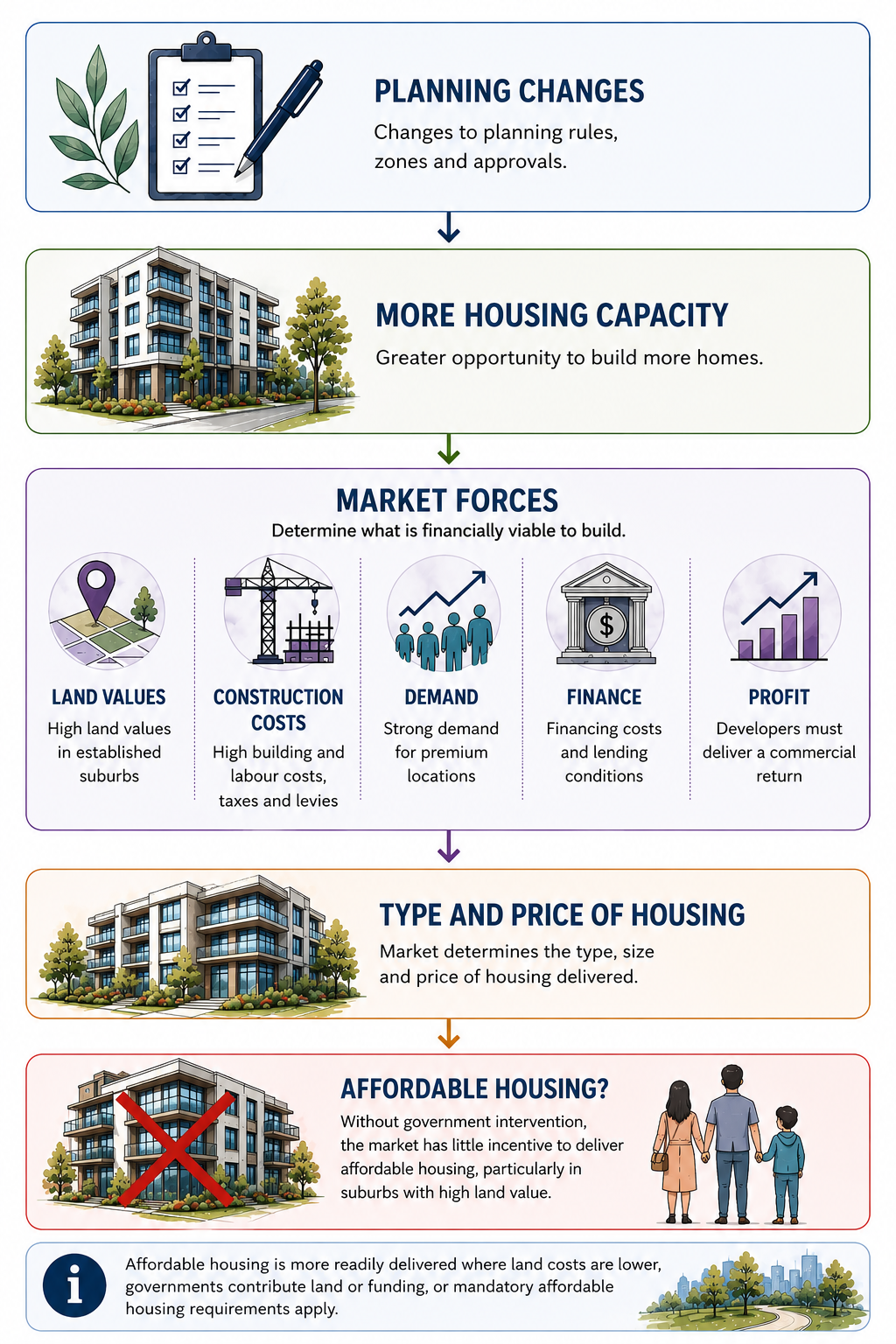
In a market-led system, developers generally build the housing that is financially viable on the land they purchase. In established high-value suburbs, this is more likely to be premium housing than housing that meets Victoria’s statutory definition of affordable housing.
This reflects several economic realities:
- Developers purchasing expensive land must recover land acquisition, construction, financing and other development costs while generating a commercial return.
- Location itself also has significant value. Buyers are paying not only for the dwelling, but also for access to established tree canopy, quality schools, public transport, parks, shopping strips and proximity to the CBD.
- Developers have reported that the cost of delivering new apartments often exceeds the prices many buyers are willing or able to pay, making it difficult to provide new housing at lower price points.
- Apartments are generally more expensive to build per square metre than detached houses.
- Taxes, levies and infrastructure contributions add to development costs.
- As a result, redevelopment in established suburbs such as those in Boroondara is generally directed towards higher-priced apartments and townhouses for buyers who can afford premium locations.
Affordable housing is more readily delivered where land costs are lower, governments contribute land or funding, or specific affordable housing requirements apply. Those conditions are very different from market-led redevelopment on high-value residential land.
Without government intervention such as mandatory inclusionary requirements, subsidies or other affordable housing mechanisms the market has little incentive to deliver housing that meets the statutory definition of affordable housing.
Where is the evidence?
The Victorian Government has consistently argued that increasing housing supply through planning reform will improve affordability. However, concerns have been raised about the limited public availability of modelling demonstrating how the planning changes are expected to affect housing supply and affordability.
These issues have also been recognised by housing economists, developers, planners and a Victorian Parliamentary Inquiry. The Inquiry concluded that little convincing evidence had been presented that the planning changes would guarantee additional housing supply, and no substantive evidence had been advanced that they would provide additional affordable housing (Read Inquiry Report).
For more information, see Resources → Media coverage → Affordable housing.
Market forces in Boroondara
Boroondara contains some of Melbourne’s highest-value residential land. Recent median house prices range from around $2 million to almost $2.8 million. As a result, new housing is generally marketed at prevailing market prices rather than at prices affordable to low- or moderate-income households.
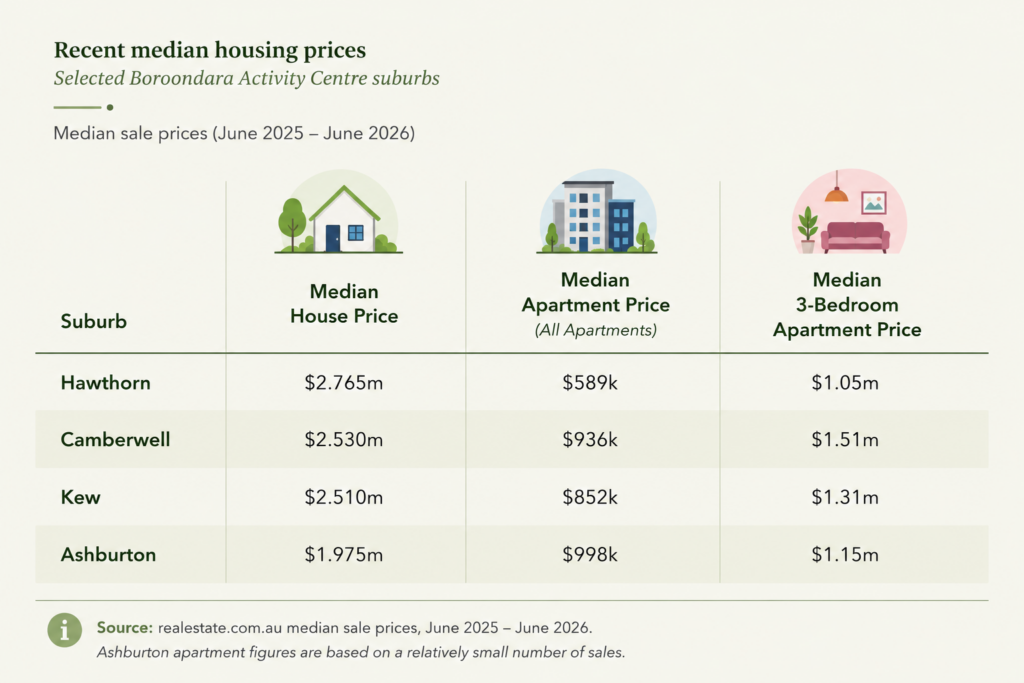
While apartment prices vary across the municipality, larger apartments suitable for families commonly exceed $1 million and, in some suburbs, more than $1.5 million. These prices place many family-sized homes beyond the reach of the households the planning changes are intended to assist.
Older apartment buildings that provide comparatively lower-cost housing are now being replaced with substantially more expensive developments further reducing availability of affordable housing in Boroondara.
Many new projects are marketed as spacious boutique residences with premium finishes, attractive landscaping and high-quality amenities. They are primarily aimed at higher-income buyers and downsizers rather than households seeking genuinely affordable housing.
The following examples illustrate the prices currently being asked for new apartments in some of Boroondara’s recent developments:
- Jardin House, Camberwell – two-bedroom apartments from $1.235 million, with three-bedroom apartments up to $3.23 million.
- Camberwell House – two-bedroom apartments from $1.35 million and three-bedroom apartments from $2.4 million.
- Luxe Living Camberwell – two-bedroom apartments available for long-term lease from $1,450 per week.
- The Woodburn, Scotch Hill Gardens (Hawthorn) – two-bedroom apartments from $1.095 million and three-bedroom apartments from $1.55 million.
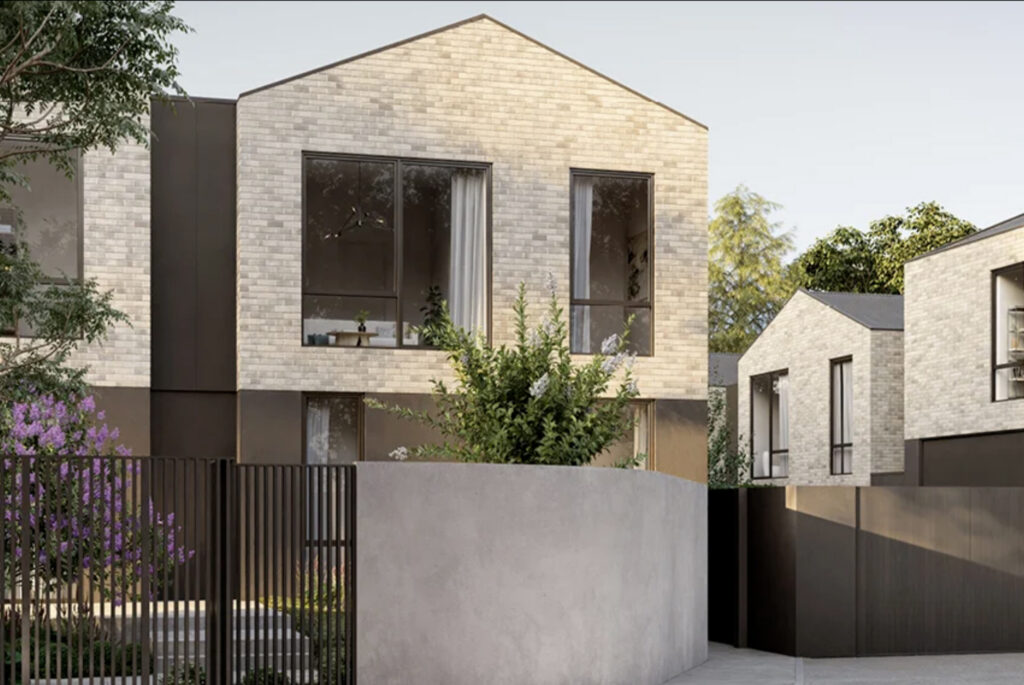
These examples highlight an important distinction. Planning changes can increase housing capacity, but market forces largely determine the type and price of housing that is ultimately delivered.
The Development Facilitation Program (Affordable Housing)
The Development Facilitation Program is promoted as a way of increasing affordable housing by offering planning concessions to major developments.
However, affordable housing is not always delivered within the development itself. Developers may instead make a financial contribution to the Social Housing Growth Fund, and approved affordable housing commitments may later be varied or reduced.
These examples raise broader questions about whether planning concessions are delivering the public benefits used to justify them.
Find out more: Government plans → Development Facilitation Program (Affordable Housing)
Opening doors — but for whom?
The Victorian Government has frequently described the planning changes as “opening doors” for young people and families wishing to live in established suburbs.
Whether those doors are genuinely opened depends not simply on the number of new homes built, but on who can afford to buy or rent them.
Public messaging has focused largely on increasing housing supply, while giving less attention to the economic factors that determine the type and price of housing ultimately delivered by the market, particularly in established high-value suburbs.
Without stronger mechanisms to deliver genuinely affordable housing, there is a risk that public expectations about who will benefit from the planning changes may exceed what the market is likely to deliver.
Ultimately, the success of the planning changes will depend not simply on the number of homes built, but on whether they are affordable to the households the Government says they are intended to assist.
Fast-track programs and affordable housing
The Victorian Government has introduced a number of planning pathways intended to encourage the delivery of affordable housing, including the Development Facilitation Program (DFP) and other fast-track approval processes.
While these programs include or encourage an affordable housing component, concerns have been raised about the scale of these contributions, how consistently they are secured, and whether they are sufficient to deliver meaningful increases in genuinely affordable housing.
For a detailed explanation of these programs, see Government plans → Development Facilitation Program (Affordable Housing).
What this means for Melbourne
Housing affordability is not only about how many homes are built — it is about who those homes are built for, what type of housing is delivered, and whether people can realistically afford to live in it.
If new housing is predominantly higher-priced apartments or investor-focused stock, then increasing housing supply alone may do little to improve affordability for the households most in need.
The current planning changes are based on the expectation that increasing housing supply will improve housing affordability. However, without stronger and enforceable affordable housing mechanisms and clearer delivery requirements, there is a significant risk that affordability outcomes will fall short of public expectations.
Planning changes determine what may be built. Market conditions determine what is financially viable to build.
Explore related topics
These planning issues are closely connected. You may also be interested in:
- Government Plans
Overview of the planning changes intended to increase housing supply. - Concerns → Is planning the barrier?
Is planning really the main barrier to solving Victoria’s housing shortage? - Concerns → What are the alternatives?
Was market-led redevelopment the only option, or were there alternatives? - Resources → Media coverage → Affordable housing
Independent reports, research and media coverage on housing affordability.