
How do the planning changes fit together?
The planning changes are not isolated reforms. They form an integrated planning framework designed to facilitate more apartment development across Melbourne’s established suburbs. Each change removes or modifies a different barrier to redevelopment. Together, they reshape how Melbourne grows.
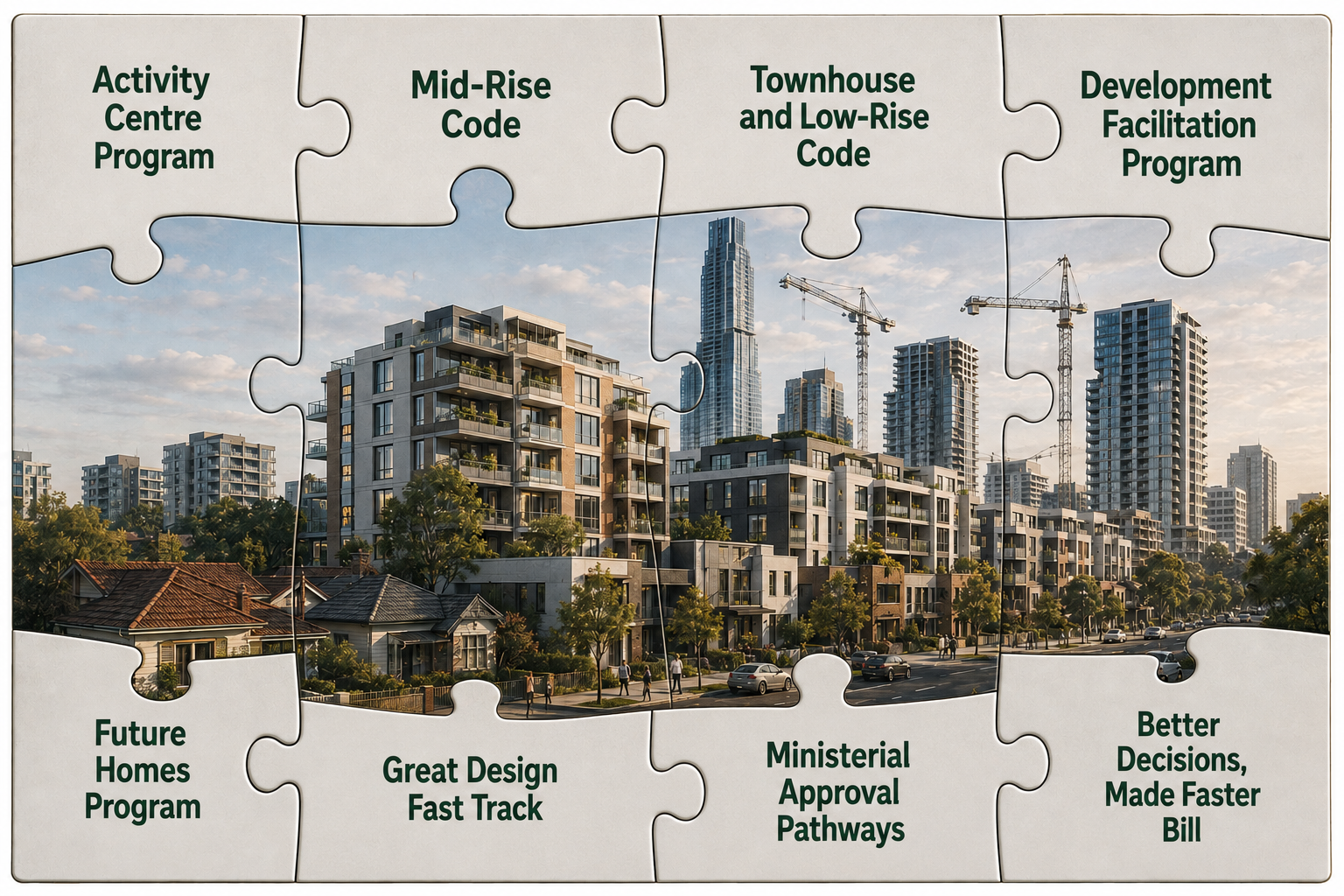
The Government plans section explains each of the Victorian Government’s major planning changes individually, including the Activity Centres Program, new building codes, fast-track programs and other planning amendments.
Viewed in isolation, each reform appears to address a specific planning issue. This page steps back to show the bigger picture.
Taken together, the reforms form a coordinated planning framework. Some determine where redevelopment is encouraged. Others determine what can be built. Others change how planning decisions are made and how development is assessed and approved.
Understanding how these changes interact provides important context for the Government’s broader vision for housing growth across Melbourne’s established suburbs. Taken together, they amount to an integrated suite of reforms designed to facilitate the transformation of Melbourne into a much denser city of apartments.
Three parts of one planning framework
The reforms work together to reshape Melbourne’s established suburbs in several ways.
- Where redevelopment is encouraged –
The Activity Centres Program and Future Homes Program identify where higher density housing is encouraged, while initiatives such as the Development Facilitation Program and Great Design Fast Track create additional pathways for development. - What can be built –
The Mid-Rise Code and Townhouse and Low-Rise Code establish new development standards that determine the scale and form of redevelopment. The Mid-Rise Code is designed specifically to facilitate urban transformation within designated redevelopment areas. - How redevelopment is facilitated (how decisions are made) –
The Better Decisions, Made Faster legislation and deemed-to-comply, fast-track and Ministerial approval pathways associated with the Codes and other planning reforms streamline planning processes and reduce barriers to redevelopment.
Viewed individually, each reform addresses a particular aspect of the planning system. Viewed together, they create a coordinated framework designed to facilitate more apartment development across Melbourne’s established suburbs.
Planning pathways
The Government has also introduced new planning pathways designed to streamline approvals.
- Deemed-to-comply — developments meeting specified standards (one-size-fits-all) receive a streamlined assessment.
- Fast-track — applications are assessed through accelerated approval pathways.
- Ministerial approval pathways — some applications are determined by the Minister for Planning rather than the local council.
These pathways are intended to reduce the time and complexity involved in approving new housing.
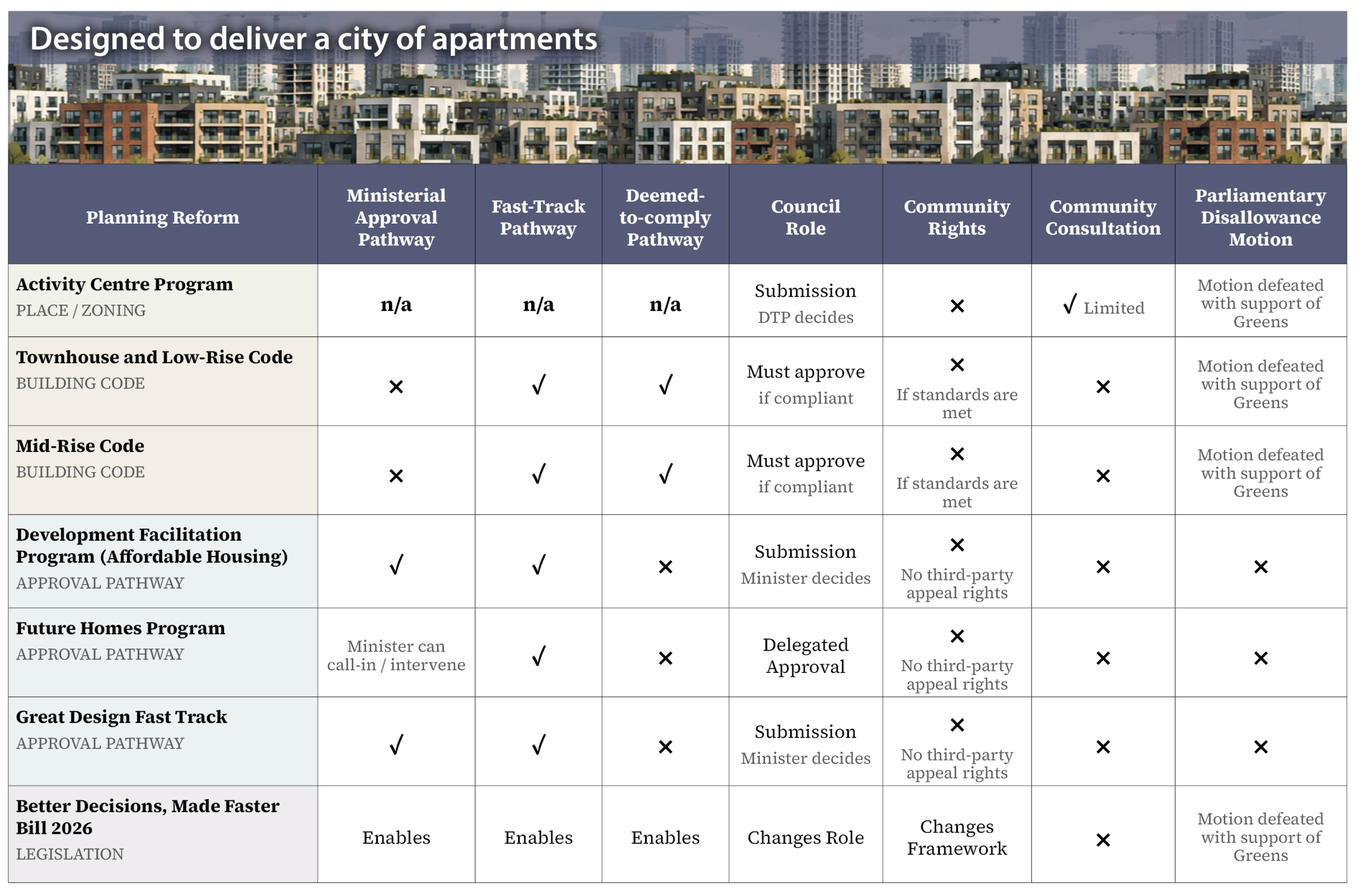
They do so by reducing the level of planning assessment and, in some cases, limiting or removing council involvement, community objection and appeal rights.
What does the whole planning system look like?
How was the extensive program introduced
These reforms were not released as a single package. Instead, they were introduced one after another through separate planning amendments, programs and legislation. This made it difficult for councils, communities and other stakeholders to fully assess how the changes would interact before they were implemented. Only the Activity Centres Program has had any community consultation.
The extent of political involvement in the selection of activity centres and the boundaries of their catchments is unclear. A large proportion of the 60 activity centres are concentrated in Boroondara, Stonnington, Bayside and Whitehorse — municipalities containing some of Melbourne’s higher-value residential land. The Government has not made public the full decision-making process or evidence used to determine why particular centres and catchments were selected.
Property and development industry representatives met repeatedly with Government during the development of the new building Codes, while councils had limited involvement and the wider community was not consulted on the Codes themselves. Details of the Codes were also withheld from communities during Activity Centres Program consultation and engagement, including from participants in Community Reference Groups.
This raises an obvious question:
Why were those who stood to benefit under the new rules given opportunities to contribute to their development while the communities that would live with their consequences were not?
Two parliamentary disallowance motions sought to overturn key elements of the reforms. In 2025, a motion to disallow the Activity Centres Program and Townhouse and Low-Rise Code was defeated after the Greens joined Labor in voting against it in the Upper House. In 2026, a further motion relating to the Activity Centres Program and Mid-Rise Code was also defeated after the Greens again voted with Labor against disallowance.
Explore related topics
You may also be interested in:
- Bulldozing Melbourne
See how these planning reforms combine to create the Government’s broader vision for Melbourne’s established suburbs. - Concerns
See how this integrated planning framework may affect neighbourhood character, liveability and community involvement.