
Development Facilitation Program (Affordable Housing)
A non-transparent planning pathway that bypasses local councils and local planning rules, concentrates decision-making behind closed doors and creates greater scope for political influence, opaque agreements and cronyism.
Affordable housing should be a mandatory condition of receiving planning concessions — not something that can be substituted with a financial contribution to the Social Housing Growth Fund, a process that is itself opaque and lacks public transparency and accountability.

At a glance
- The Development Facilitation Program allows eligible developers to bypass the normal council planning process and apply directly to the Planning Minister.
- Developers and the State Government may negotiate significant aspects of a proposal behind closed doors before it is publicly lodged, without council or community involvement.
- The program can provide significant planning concessions, including additional height above local planning controls.
- The 10% affordable housing contribution can be replaced by a financial contribution to the Social Housing Growth Fund, meaning no affordable housing need be delivered within the development itself.
- Affordable housing commitments may be varied or reduced after approval and are not necessarily secured in perpetuity. Financial contributions also need not deliver affordable housing in the same municipality.
- A planning permit does not require a developer to build, so the housing and affordable housing used to justify an approval may never be delivered.
What is the Development Facilitation Program (Affordable Housing)?
A planning pathway for large-scale developments, typically valued at $50 million or more, that allows developers to bypass the normal council planning process and apply directly to the Planning Minister in exchange for an affordable housing commitment.
Rather than being assessed through the normal council planning process, these developments are decided by the Planning Minister. Councils are given just 14 days to prepare a submission before the Minister makes the final decision.
But the process does not begin when an application is lodged. Before the public or local councils even know a proposal exists, developers and the State Government are already negotiating behind closed doors.
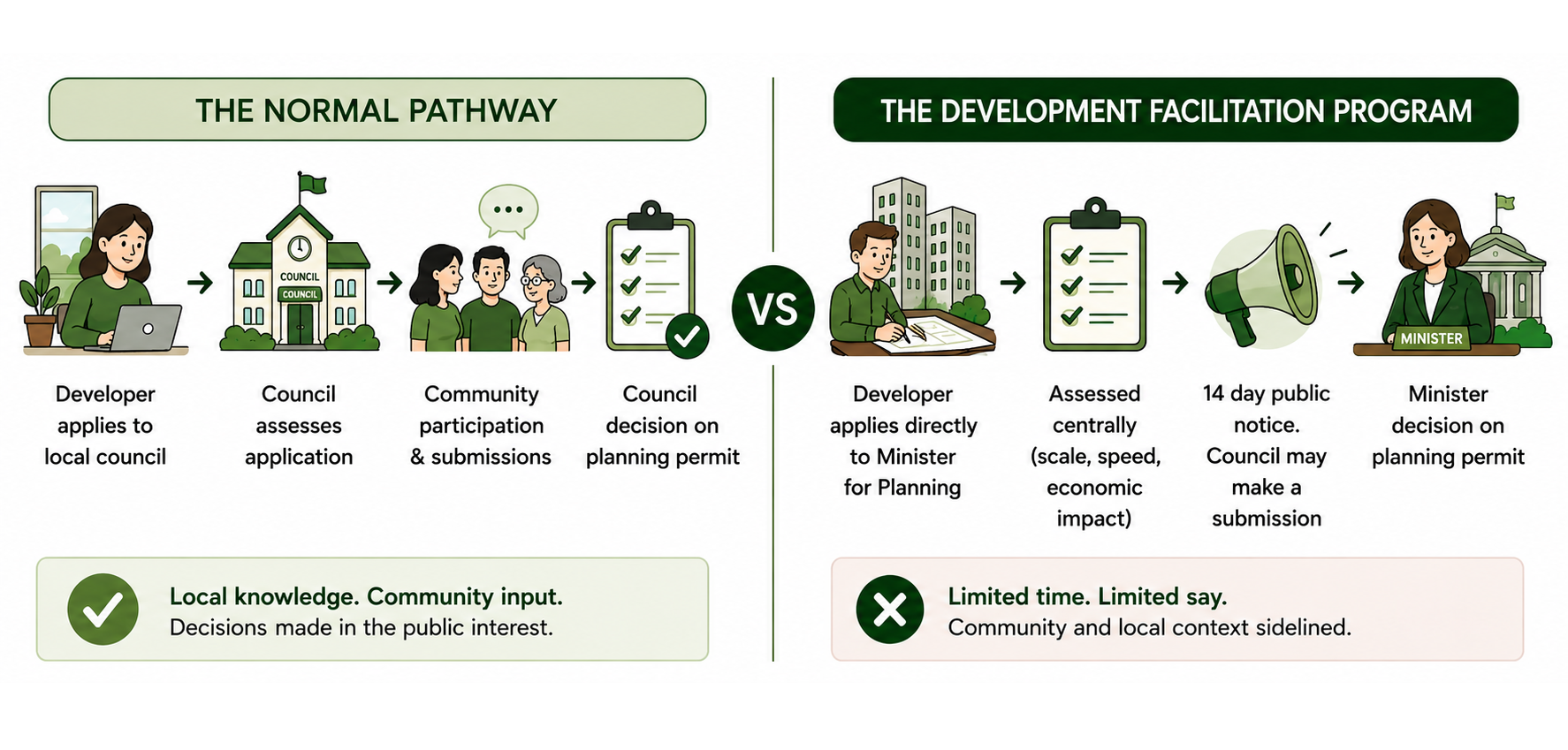
Although the program is promoted as delivering affordable housing, developers can receive significant planning concessions without providing a single affordable home within the development itself.
Why transparency matters
The Development Facilitation Program removes planning decisions from local councils and concentrates them within the State Government.
Planning concessions that would normally be negotiated through an open council process are instead negotiated behind closed doors between developers and the State Government. Local councils are shut out of these negotiations, and neither councils nor the public can see the discussions, the advice provided or the agreements reached before an application is lodged.
When major planning concessions are negotiated through confidential discussions rather than open local planning processes, public scrutiny is reduced and the safeguards against political influence, opaque agreements and cronyism are weakened.
The Development Facilitation Program is justified on the basis that it delivers affordable housing. But does it?
Does the program deliver affordable housing?
Not necessarily. Affordable housing is the principal justification for the Development Facilitation Program. However, the delivery of those benefits is uncertain because affordable housing is not always required within the development itself, commitments may later be varied or reduced, and some affordable housing obligations are time-limited rather than permanent.
The Government states that developments should include a 10% affordable housing contribution. This may be delivered through discounted sale or gifting of dwellings to a registered housing provider, discounted build-to-rent housing, or a financial contribution to the Social Housing Growth Fund equivalent to approximately 3% of development cost. Where affordable dwellings are provided, they are generally managed by a community housing provider and offered at below-market rent to eligible households.
One of the most controversial features of the program is that developers can choose to make a financial contribution to the Social Housing Growth Fund rather than provide affordable housing within the development itself. As the ABC reported:
“Property developers are offering cash to avoid including affordable housing in luxury Melbourne apartment builds under a controversial scheme which also allows them to bypass local planning rules.” — ABC News (Read article)
The result is:
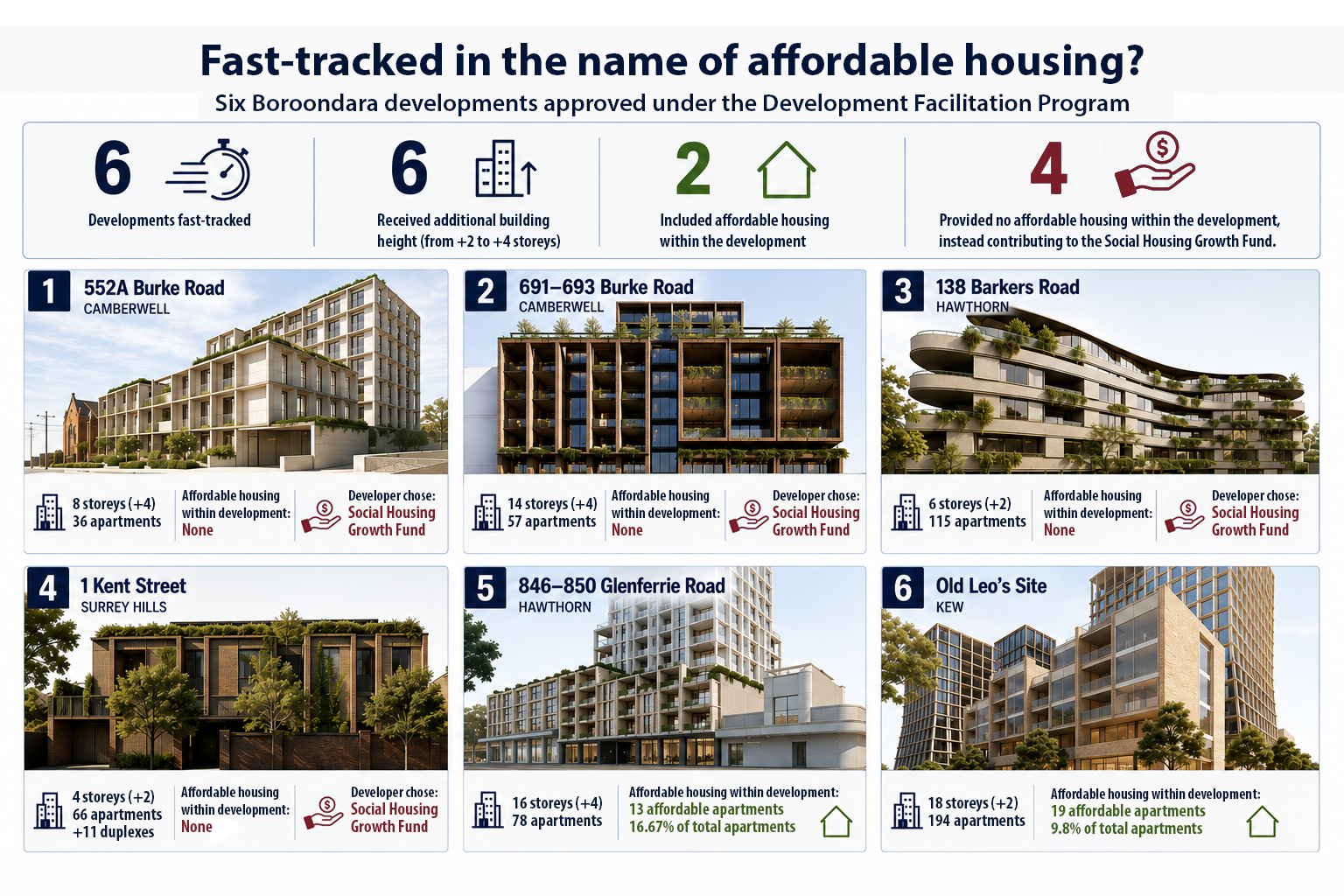
- The affordable housing contribution may be modest relative to the planning concessions and uplift in land value. For example, the Packer development at the former Leo’s site in Kew received approval for additional height, while only 19 of its proposed 194 apartments are to be affordable housing.
- Affordable housing may be substituted by financial contributions to the Social Housing Growth Fund rather than delivered within the development itself.
- The Social Housing Growth Fund is itself an opaque mechanism with limited public transparency and accountability, and there is no requirement that funds be invested in the municipality where the development occurred. This is significant because the Government promotes the program as “opening doors” to higher-value suburbs. However, where affordable housing is substituted by a financial contribution, there is no requirement that equivalent affordable housing be delivered in the same community.
- Affordable housing commitments can be weakened, varied or effectively avoided after approval, as occurred in the Assemble developments at Brunswick and Coburg, where the promised number of affordable dwellings was substantially reduced following approval.
- Affordable housing outcomes are not necessarily secured in perpetuity.
As a result, the long term delivery of affordable housing benefits remains uncertain and may not reflect the scale of the planning concessions provided.
The Government promotes the Development Facilitation Program as a way to deliver affordable housing. The six Boroondara approvals below show how that pathway has operated in practice. Each development received significant planning concessions, most notably additional height above discretionary and, in some cases, mandatory height limits.
Affordable housing commitments may not always remain unchanged after approval. As The Age reported of two Assemble developments approved under the Development Facilitation Program in Brunswick and Coburg:
“A developer that branded itself the ethical alternative to a profit-driven industry has been permitted to turn 248 promised affordable homes into market-price units, just months before completion.” — The Age (Read article)
The following example relates to one of the two developments discussed in The Age article.
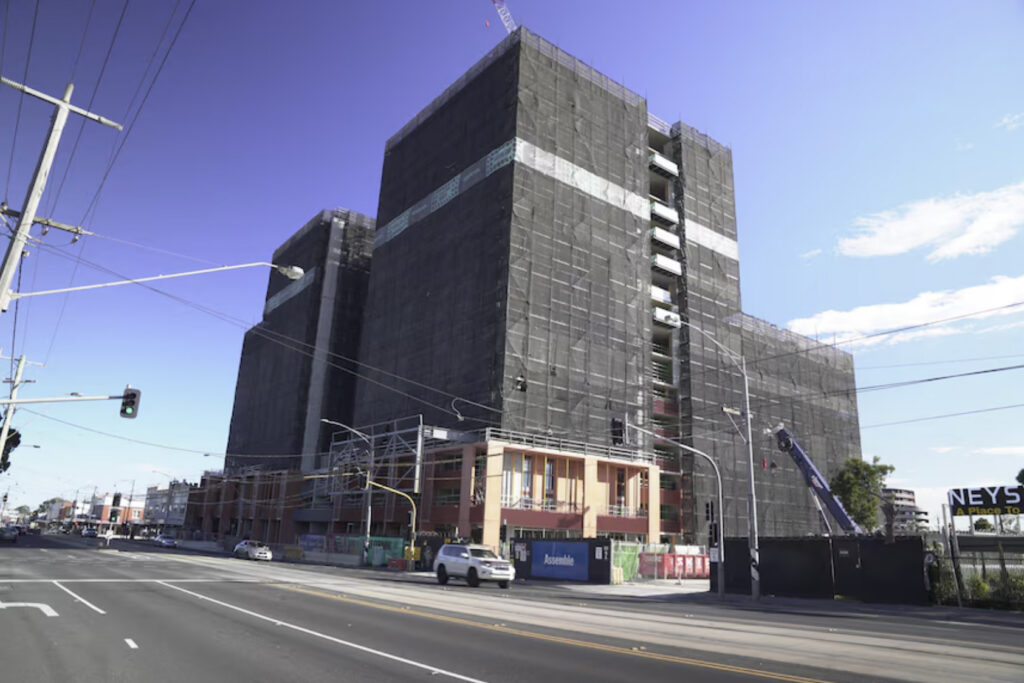
If the affordable housing benefits are uncertain, the central justification for bypassing normal planning processes, such as additional height and greater impact on neighbouring amenity, becomes much weaker.
Also see: Concerns → Affordable Housing.
What happens before an application is lodged?
A significant part of the Development Facilitation Program occurs before an application is publicly lodged.
During this stage, discussions between developers and the State Government may take place over an extended period, including matters such as project viability and design.
These discussions occur behind closed doors, without council involvement and outside the public planning process. The public has no visibility of these discussions, the advice provided or the agreements reached before an application is lodged.
By the time an application is publicly exhibited, many of the key discussions and negotiations may already have taken place, reducing opportunities for meaningful council and community input.
Once councils are notified, they are also subject to confidentiality requirements that limit what they can publicly discuss or release.
The traditional pre-application process gave councils an opportunity to work with applicants to improve proposals before they were lodged. Better setbacks, landscaping, tree retention, heritage responses and neighbourhood outcomes could often be negotiated early. Those opportunities are largely removed under the Development Facilitation Program.
Faster approvals. Fewer safeguards.
The program is promoted as a way to accelerate housing delivery by reducing delays in the planning system. However, the lengthy pre-application process, including project viability testing, raises questions about whether approvals are genuinely delivered faster.
Despite the intention that projects would be “shovel ready”, councils are reporting that the construction lag following approval is increasing.
The program also seeks to reduce delays associated with objectors seeking review at VCAT, even though a dedicated fast-track process at VCAT had already substantially reduced that risk to just a few months.
While permits are issued more quickly, this is achieved by removing many of the checks and balances that normally apply through local planning, including:
- Reduced detailed local assessment.
- Limited transparency in decision-making.
- Greater flexibility to vary planning controls, including setbacks.
- Prioritising economic impact and development yield over local planning considerations.
For more information see: Concerns → Community and Council locked out
Permits without delivery
Receiving a planning permit does not require a developer to build anything.
There is no obligation for a developer to proceed with a project once a permit has been granted. The uplift in land value created by a planning permit can instead be realised by holding or selling the site, meaning the housing used to justify the approval may never be delivered.
Poor planning outcomes are already emerging
The consequences are already evident in Boroondara.
For example, one Ministerially approved development in Boroondara would leave adjoining open space with only one hour of winter sunlight.
By removing councils from the design process, opportunities to improve developments before approval are significantly reduced.
What communities are left with
In practice, communities often experience:
- Permanent changes to neighbourhood character and infrastructure demand.
- Limited ability to shape or challenge outcomes.
- Reduced transparency throughout the approval process.
- Uncertainty about whether promised public benefits will ultimately be delivered.
Meanwhile, affordability outcomes are not guaranteed.
What this means for Melbourne
The Development Facilitation Program represents more than a faster approval pathway. It reflects a broader shift towards centralised, state-controlled planning approvals for major developments.
The Development Facilitation Program is not an isolated reform. Together with other planning reforms, it is creating a parallel planning system — one that increasingly sidelines local councils, weakens local planning schemes and concentrates planning power within the State Government.
By prioritising speed and development yield over local planning, transparency and accountability, the connection between development approvals and enforceable community benefits is weakened.
The result is a planning system in which large-scale developments may proceed more quickly, while the long-term impacts are absorbed locally. The affordable housing and public benefits used to justify those approvals remain uncertain.
The decision-making process increasingly takes place behind closed doors, with less transparency and accountability to the communities affected.
Explore related topics
You may also be interested in:
- Concerns → Affordable housing
Examines whether market-led redevelopment is likely to deliver genuinely affordable housing. - Concerns → Community and council locked out
Explores how planning powers have shifted from local councils to the State Government. - Bulldozing Melbourne → Decisions behind closed doors
How planning decisions are increasingly made without public scrutiny. - What we want → Transparent, accountable & efficient planning
Our principles for a planning system that is transparent, accountable and shaped with communities.