
The false “BUILDER vs BLOCKER” narrative
The Victorian Government has repeatedly framed planning reform as a contest between “Builders” and “Blockers” — a politically convenient narrative that casts supporters as part of the solution and critics as standing in the way. Complex questions about housing, planning and Melbourne’s future deserve evidence and genuine debate, not slogans designed to dismiss legitimate concerns.
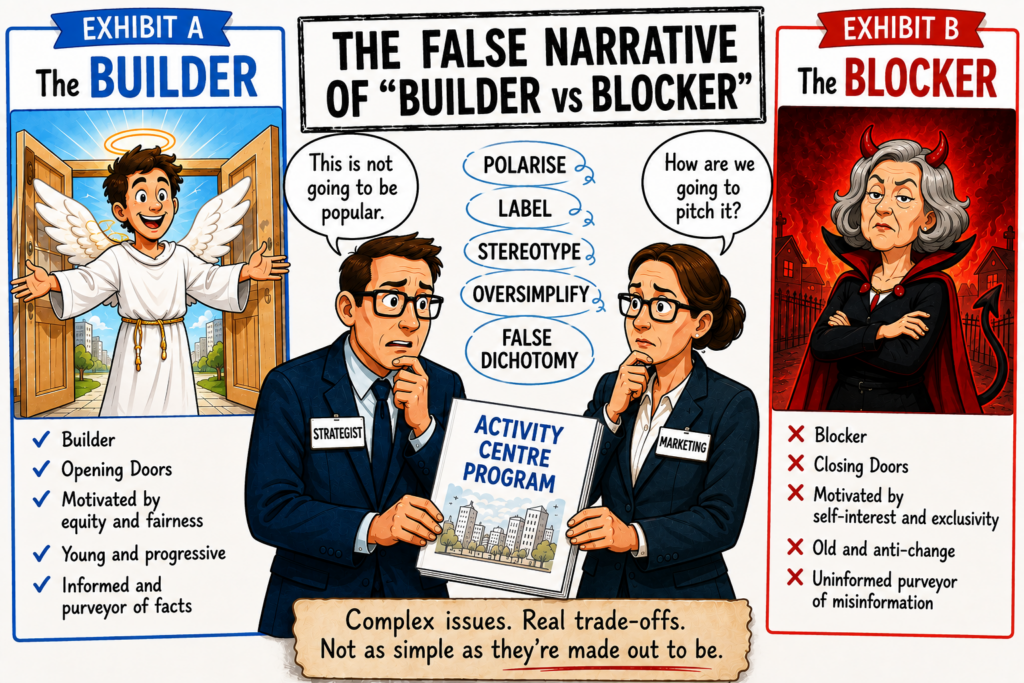
Disagreeing with a planning proposal is not the same as opposing housing.
Yet critics of the Government’s planning changes have repeatedly been labelled “blockers”, while supporters are positioned as “builders”. This framing turns a complex planning debate into a contest between motives rather than ideas.
Planning change of this significance depends not only on good policy, but on good public discussion. When legitimate questions about housing, infrastructure, environment, heritage, liveability and democratic participation can be dismissed with a label, the quality of that discussion suffers. Slogans and stereotypes do not answer legitimate questions — they make it easier to shut down the people asking them.
At a glance
- “Builders vs Blockers” creates a false choice between supporting housing and opposing it.
- Many people labelled “NIMBYs” support additional housing but question where, how and under what planning framework it should be delivered.
- Political slogans and stereotypes shift attention away from the planning issues themselves and make legitimate concerns easier to dismiss.
- Media attention focused heavily on towers and social stereotypes, while many Victorians remain unfamiliar with the broader planning changes, particularly walkable catchments and the new planning codes.
- The way reforms are communicated shapes what the public notices — and what it does not.
Planning is more complex than a slogan
Good planning depends on evidence, transparency and respectful debate. It is rarely a simple choice between “yes” and “no”.
Yet discussion about Victoria’s planning changes has often been framed as a contest between those who support housing and those who oppose it, despite many councils, planning professionals, academics, community groups and residents labelled “NIMBYs” also supporting additional housing.
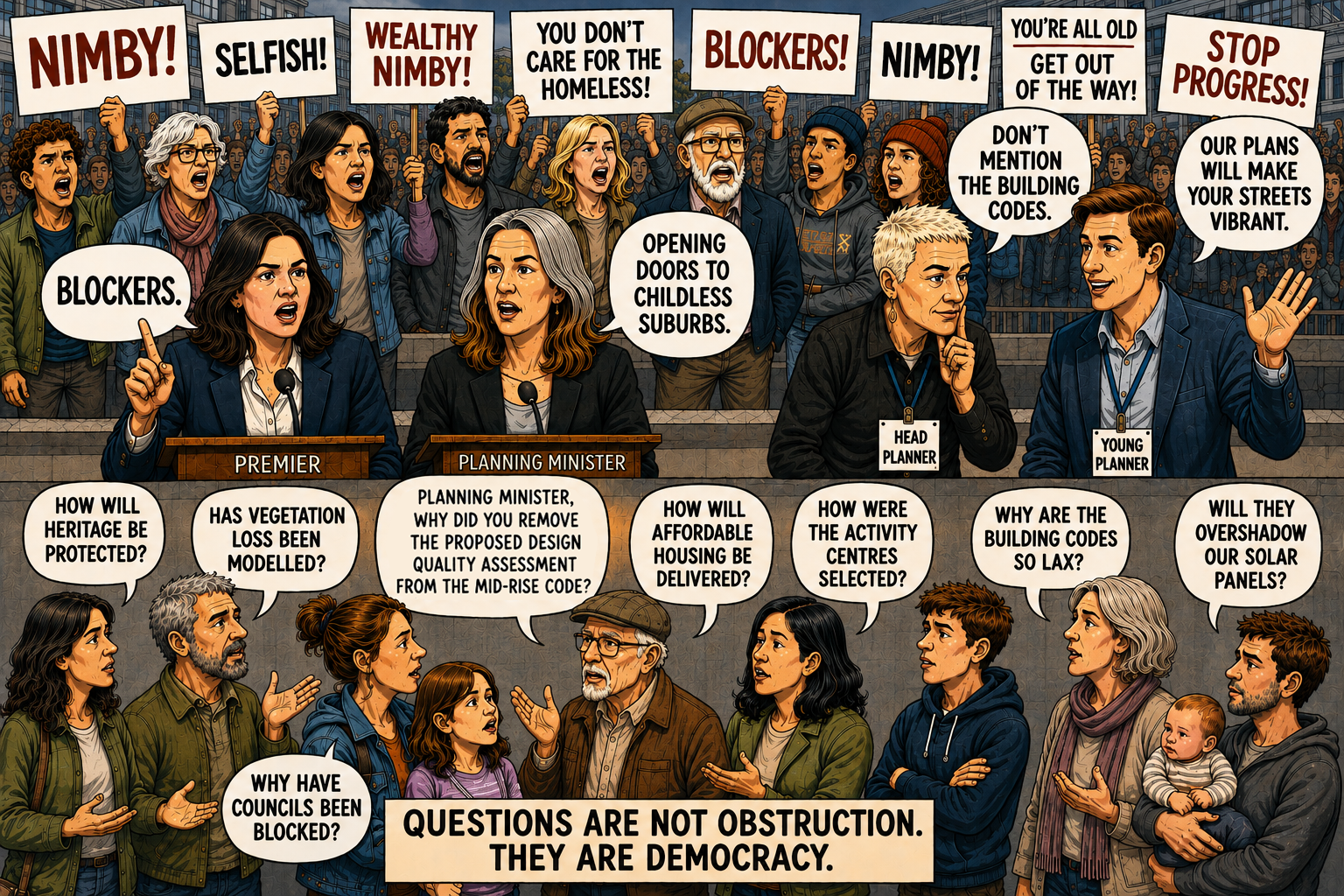
At the same time, they raise legitimate questions about where housing should be located, what type of housing is needed, how infrastructure will keep pace, and how environmental, heritage and liveability impacts should be managed.
These are planning questions — not arguments against housing itself.
Good planning involves balancing competing public interests. Reducing those discussions to “builders vs blockers”, as the State Government has frequently done, oversimplifies those competing interests and obscures the real planning questions.
Labels change the conversation
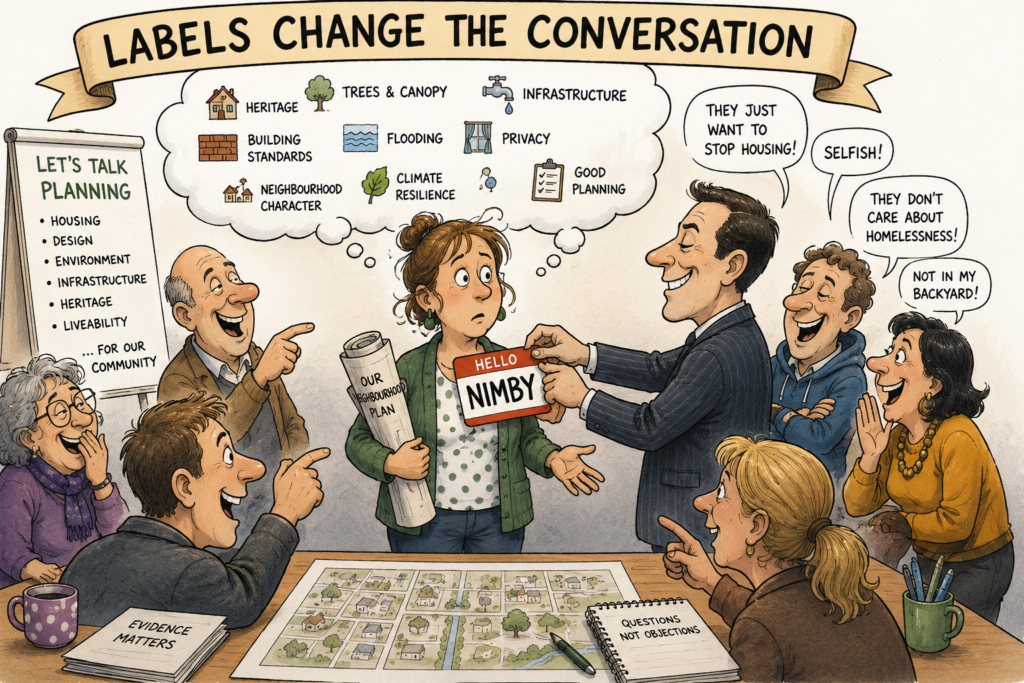
Labels do more than simplify debate — they change it. Describing one side as “Builders” and the other as “Blockers” associates one with creating homes and solving problems and the other with obstruction. Attention shifts from the planning arguments themselves to the perceived character and motives of the people making them.
Moral attacks — suggesting someone doesn’t care about homelessness, is selfish, or doesn’t want “those sort of people” in their neighbourhood — are used to discredit critics and shut down debate rather than engage with the planning issues they raise. Instead of discussing planning, people find themselves defending their character. Some may decide it is easier to remain silent than risk being dismissed with a label.
Legitimate concerns about liveability, building standards, developer-led design, character and heritage, trees and gardens, climate resilience and other planning issues can then be recast simply as barriers to housing delivery.
When public debate encourages us to judge the person before the argument, we all become less able to evaluate complex planning policy.
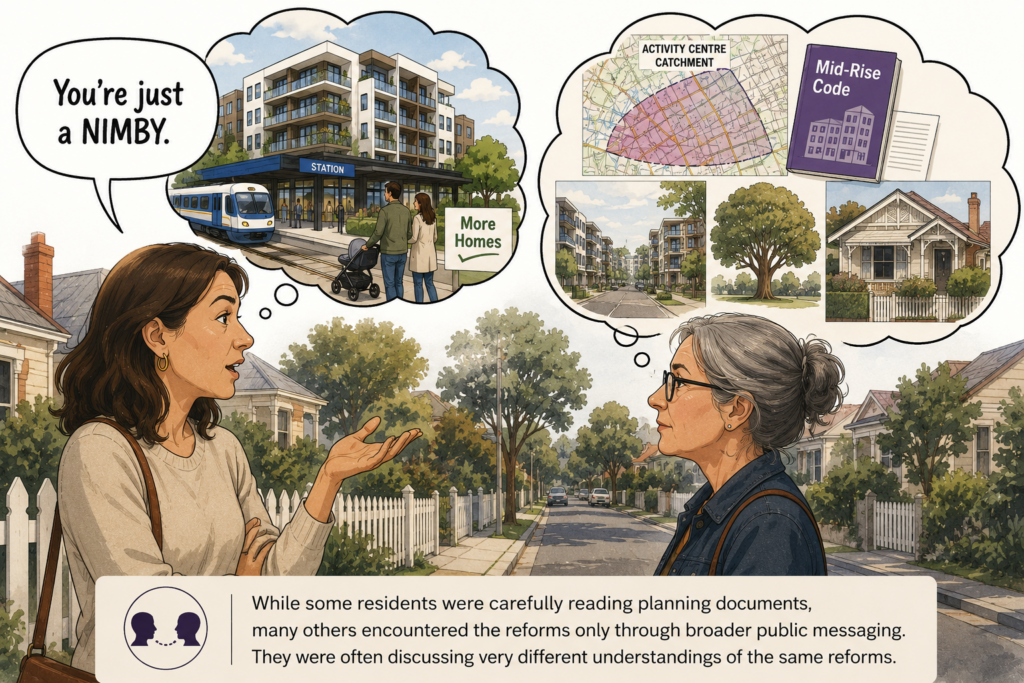
While some residents were carefully reading planning documents and asking detailed questions about planning Codes, building standards and activity centre catchments, much of the wider public encountered the reforms only through broader public messaging.
This lack of detailed public awareness mattered. Because many people did not realise that the planning changes extended well beyond activity centre cores into surrounding residential catchments, opposition could easily appear to be little more than resistance to higher-density development around railway stations. This reinforced the “NIMBY” stereotype and obscured the broader planning issues being raised.
How the public narrative was shaped
Planning scholars Crystal Legacy, Chris Gibson and Dallas Rogers have argued that public participation can sometimes become more of a public relations exercise than a genuinely deliberative planning process, with critics labelled “NIMBYs” or otherwise treated as illegitimate participants. Their work provides one lens through which to consider the communication surrounding Victoria’s planning changes. Read: Infrastructural Gaslighting and the Crisis of Participatory Planning (Legacy, Gibson & Rogers, 2023).
Governments inevitably make choices about how policies are presented. The language they use, the stories they emphasise and the examples they select shape what the public notices — and what it does not.
The following examples illustrate some of the recurring narratives that shaped public discussion of Victoria’s planning changes.
“Builders vs Blockers”
Throughout the Activity Centre Program, planning reform was frequently presented as a contest between “Builders” and “Blockers”. The Government consistently described itself using the term “Builders”.
Unlike “Blockers”, which implies unnecessary obstruction, “Builders” evokes positive ideas of creating homes, opportunity and progress. The language itself encouraged readers to associate one side with solving problems and the other with standing in the way before the planning arguments had even been considered.
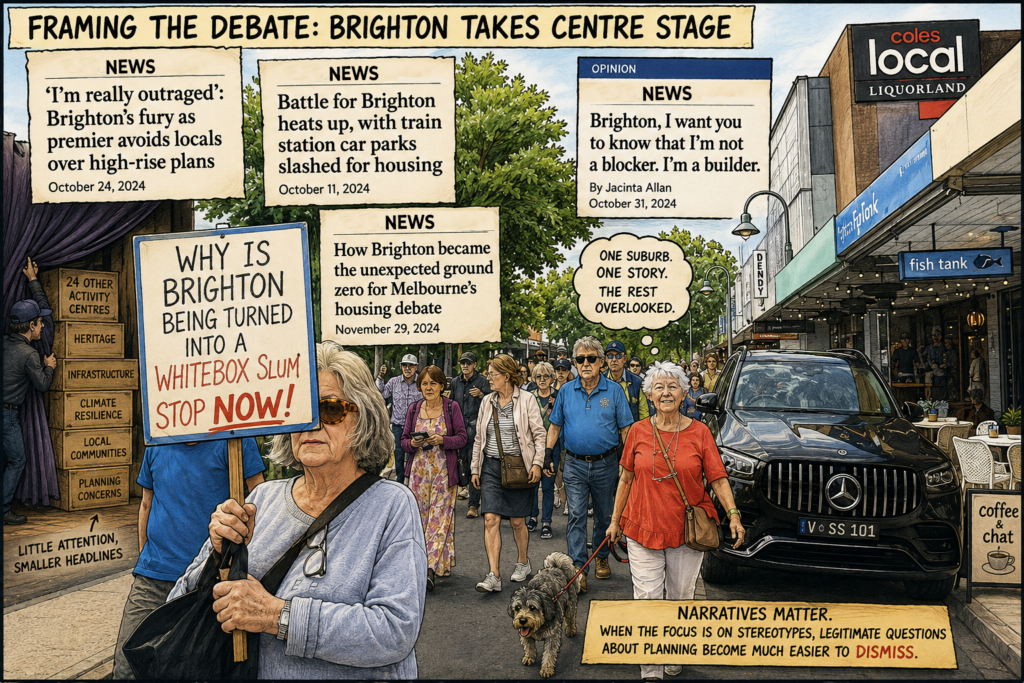
This framing was reinforced by former Premier Jacinta Allan herself, who wrote, “The blockers will block. They always have. I’m not a blocker, I’m a builder.” (Read) The contrast is rhetorically effective. Rather than simply describing competing views on planning policy, it presents one side as creating homes and opportunity while the other is characterised primarily by obstruction.
The “Builders vs Blockers” narrative was only one example of how public communication shaped the debate.
The narrative of affordable housing
Earlier public communication strongly emphasised affordable housing as the primary rationale for the planning changes. While affordability is an important public policy objective, presenting the reforms predominantly through this lens introduced a moral dimension to the debate.
As a result, questions about planning policy could easily be interpreted not simply as disagreement over how housing should be delivered, but as opposition to affordable housing itself.
More recently, however, the language has noticeably shifted. Government messaging increasingly focuses on delivering “more homes” and increasing housing supply, with claims about affordable housing far less prominent. It is an important change in emphasis: more housing and more affordable housing are not the same thing.
Whether these reforms will actually deliver affordable housing should not be assumed — it is itself an important policy question. As discussed in Concerns → Affordable housing, much of the available evidence suggests that increasing market supply alone is unlikely to produce homes that are affordable for those on low and moderate incomes.
Yet the earlier framing persists. It can obscure that distinction, encouraging the assumption that these planning changes will deliver affordable housing across all activity centres, even as affordable housing has become less prominent in the Government’s own messaging.
The way the planning changes were communicated also helped shape the media narrative. Certain themes received extensive coverage, while other aspects of the reforms attracted comparatively little attention.
Stereotypes of privilege and exclusivity
The first tranche of activity centres was announced in Brighton, one of Melbourne’s wealthiest suburbs, encouraging media coverage that focused on affluent residents resisting housing. The timing and presentation of the announcement helped steer much of the public conversation towards existing socio-economic and intergenerational divisions. As a result, concerns about planning policy were often viewed through the lens of wealth and privilege rather than assessed on their own merits, while the planning changes affecting the other 24 activity centres received comparatively little attention.
What the tower narrative obscured
While these narratives took centre stage, there was little media coverage of the walkable catchments. With public attention focused on high-rise towers, and images of towers along main roads and shopping strips dominating coverage, the planned mid-rise transformation of established family-oriented suburbs received far less scrutiny. Many people remained unaware of the walkable catchments, the Government’s long-term plans for these neighbourhoods, or that many of the new planning changes, including the Townhouse and Low-Rise Code and the Mid-Rise Code, extend beyond activity centre catchments.
More than two years after the first Activity Centres were announced, public awareness of the detail remains limited. Many Victorians are still unaware of the role of walkable catchments, the extent of the proposed neighbourhood transformation, or how widely the new planning codes apply.
“Childless Suburbs”
Later, references to “childless suburbs” reinforced broader social stereotypes that extended beyond planning itself.
In some parts of the debate, older residents came to be portrayed as obstacles to younger generations — blocking housing, resisting change and protecting privilege. This age-based framing often shifted attention away from the planning issues being raised and towards assumptions about who was making them.
The “childless suburbs” narrative is also inconsistent with Australian Bureau of Statistics data. In Boroondara, around seven in every ten classified households were family households in 2021, and the number of family households increased by approximately 9% over the previous decade. Population ageing did not mean the municipality ceased to be family-oriented.
Reducing complex communities to labels such as “childless suburbs” oversimplifies demographic change and risks stereotyping both older residents and the communities in which they live.
Together, these narratives encouraged planning concerns to be interpreted through the lens of stereotype. Legitimate questions about planning policy became easier to dismiss because they were no longer judged primarily on their merits, but through assumptions about the person raising them.
Victorians deserve better than that. Good public communication should help people understand what is changing, acknowledge legitimate concerns and encourage informed discussion — not deepen existing social divisions.
A lack of empathy for community concerns
Major planning changes affect people’s homes, neighbourhoods and sense of place. Concern about changes of this scale is neither irrational nor selfish. Even where governments believe reform is necessary, residents are entitled to have genuine concerns acknowledged and treated with respect.
Too often, that empathy has been missing from the Government’s response. Concerns have been dismissed or ignored, while slogans such as “blockers” and “NIMBYs” belittle the people raising them and imply that their concerns are not legitimate enough to warrant serious consideration.
There is something particularly troubling about portraying concerned residents as lacking empathy while showing so little empathy for them. People can support more housing and still feel distress at the prospect of losing trees, gardens, sunlight, privacy, neighbourhood character or a place they have loved and invested in for decades. Those concerns may have to be balanced against other public interests, but they should not be mocked or dismissed.
Governments should be capable of defending planning reform on its merits without belittling the people whose homes and neighbourhoods will bear its consequences.
What this means for Melbourne
Public debate increasingly encourages people to view the reforms through a moral lens: those supporting the reforms are often portrayed as helping solve the housing crisis, while those raising planning concerns risk being portrayed as obstacles to progress.
The quality of public debate surrounding the Activity Centres Program has too often been dominated by labels and stereotypes rather than the planning questions themselves. Many Victorians remain unfamiliar with the planning codes, development pathways and legislative changes that will shape Melbourne’s future.
Good planning deserves more than slogans. It deserves an informed public discussion in which evidence, competing interests and legitimate concerns can be examined on their merits. Respectful disagreement is not an obstacle to good planning — it is one of its strengths.
Explore related topics
These planning issues are closely connected. You may also be interested in:
- Government Plans
See what the Victorian Government is actually proposing beyond the public slogans and headlines. - Concerns → Affordable housing
Will these reforms genuinely improve housing affordability, or is the evidence more complex than the public messaging suggests? - Concerns → Community consultation and engagement
Were affected communities properly informed and were they ever given a genuine opportunity to influence the decisions that mattered? - Resources → Media coverage
Explore how media coverage shaped public understanding of the reforms and which parts of the planning story received far less attention. - Concerns → Is planning the barrier?
Does independent evidence support planning deregulation as the solution to Victoria’s housing challenges?