
What are the alternatives?
The Government has presented its planning changes as the only way to solve Melbourne’s housing challenges. They are not. This is not a choice between the Government’s planning model and urban sprawl. Melbourne has many ways of accommodating housing growth. The real question is why one planning model was chosen over other credible alternatives.
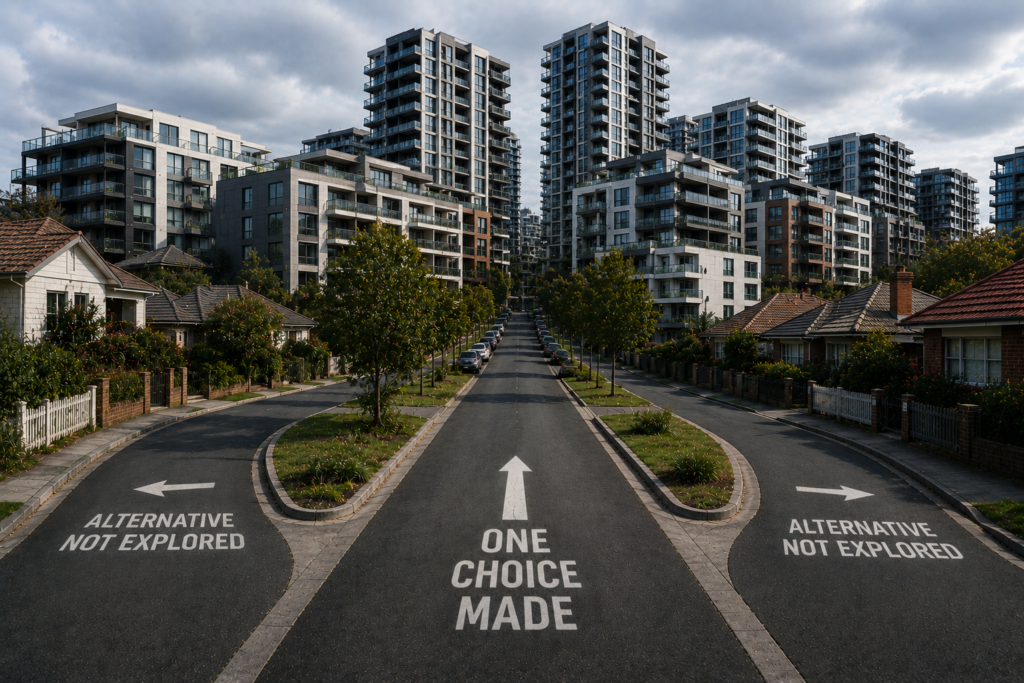
The Victorian Government has largely presented its planning changes as the necessary solution to Melbourne’s housing challenges.
However, accommodating additional housing has never depended on a single planning model. Different approaches can increase housing supply while placing different emphasis on neighbourhood character, infrastructure, environmental outcomes and local decision-making.
This page asks a simple question: is transforming Melbourne’s established suburbs the only way to accommodate future housing growth?
At a glance
- The current reforms are one planning model — not the only way to accommodate housing growth.
- Alternative approaches can increase housing supply in established suburbs while placing different emphasis on neighbourhood character, infrastructure, environmental outcomes and local decision-making.
- Many councils and planning professionals had already developed alternative housing strategies tailored to local conditions.
- Little publicly available evidence explains how different planning approaches were compared, why this model was chosen or how the trade-offs were evaluated.
- Good planning is not only about choosing a strategy — it is also about openly explaining why that strategy was preferred over credible alternatives.
What alternatives are available?
The debate is often presented as a choice between the Government’s planning model and urban sprawl. In reality, there are many different ways to accommodate housing growth, each involving different priorities and trade-offs.
The alternatives are not simply “build up” or “build out”. They include different ways of planning, sequencing and locating housing growth.
The examples below illustrate some of the planning approaches that could increase housing supply while placing different emphasis on neighbourhood character, infrastructure, environmental outcomes and local decision-making. They are not mutually exclusive and could be adopted individually or in combination.
Alternative planning approaches
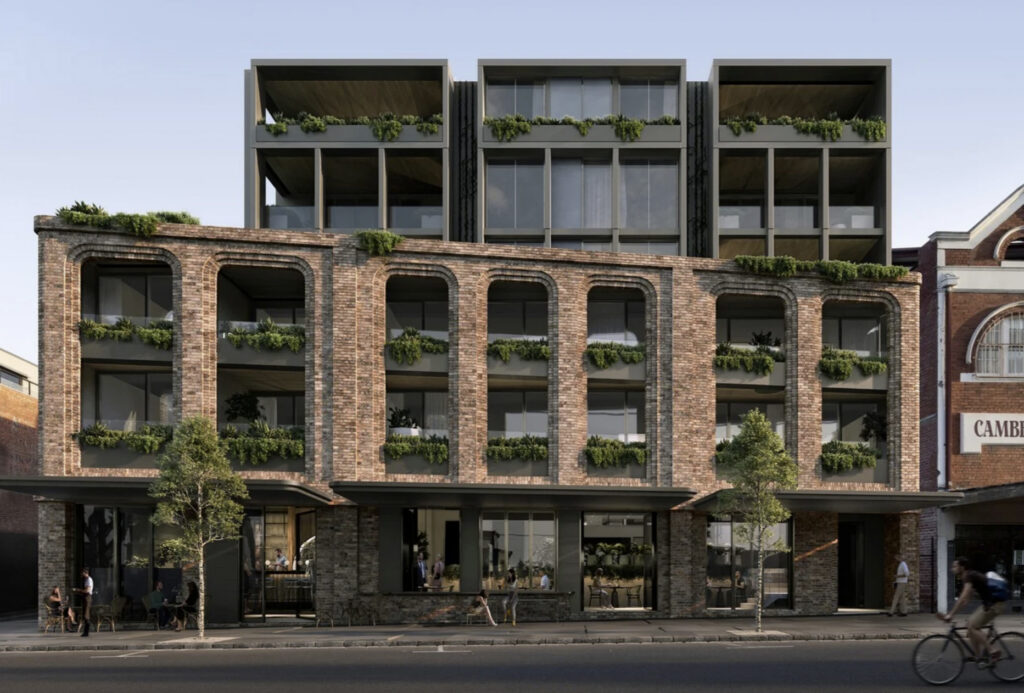
- Locally-led structure planning
Many councils had already prepared strategic plans identifying where additional housing could be accommodated while responding to local heritage, infrastructure, landscape and environmental constraints.
These plans reflect local character, infrastructure capacity and environmental conditions rather than applying a uniform “cookie-cutter” planning model across diverse suburbs and neighbourhoods.
Such plans can also incorporate neighbourhood-specific design standards that respond to local character while still providing developers with planning certainty.
- Better utilisation of existing development capacity
Victoria already has substantial approved housing that has not yet been constructed. Better utilisation of this existing capacity could increase housing supply without immediately expanding development into additional established neighbourhoods. See: Concerns → Is planning the barrier? - Stronger regional development strategies
Encouraging more employment, infrastructure and services in regional centres could help reduce development pressure on Melbourne while supporting economic growth across Victoria. A stronger regional development strategy may provide more people with genuine choices about where they live and work. - Targeted growth in appropriate locations
Growth can be concentrated more heavily around major transport corridors, larger activity centres and areas with greater employment and infrastructure capacity, where redevelopment may have achieved better alignment with transport, employment and infrastructure objectives, while also providing greater opportunities to deliver affordable housing than widespread upzoning of established residential neighbourhoods. See Concerns → Affordable housing. - A broader mix of housing types
Rather than relying primarily on market demand to determine what is built, it is possible to develop planning policy that encourages a broader mix of housing sizes and types that better reflect the needs of different households, including families, first-home buyers, downsizers and older residents.
Without measures to encourage a balanced mix of housing, redevelopment will increasingly favour the housing products that are most commercially attractive rather than those most needed by the community.
Over time, the cumulative replacement of family homes with predominantly smaller dwellings may reduce the availability of family-sized housing in established suburbs. - Mandatory affordable housing requirements for new developments
Unlike Victoria, some jurisdictions require developers to include a proportion of genuinely affordable housing in new residential developments, or make an equivalent affordable housing contribution.
Mandatory inclusionary zoning is one mechanism that recognises market forces alone are unlikely to deliver housing that is genuinely affordable to lower-income households.
xx
Alternative decision-making approaches
- Improved planning processes
The efficiency of the planning system could be improved without substantially changing where or how development occurs. Streamlining permit processes, reducing unnecessary delays and increasing planning resources are examples of measures that could have been considered alongside broader planning changes. - More detailed modelling of housing capacity
Alternative approaches could also have been supported by more detailed public modelling of housing capacity, infrastructure constraints and likely housing outcomes.
Transparent evidence would allow governments and communities to compare different planning options and better understand the trade-offs involved.

Other planning models already existed
These alternatives are not hypothetical.
Victorian councils and independent planning professionals had already developed planning models that accommodated housing growth while responding to local conditions and community priorities.
Council-led planning
A number of Victorian councils had already prepared strategic plans to accommodate additional housing growth.
For example, Boroondara and Stonnington identified opportunities for increased housing through locally developed planning strategies that sought to balance growth with neighbourhood character, heritage, infrastructure and environmental considerations.
Both municipalities demonstrated that more housing could be accommodated without relying on extensive residential catchments or uniform planning controls.
Independent planning proposals
Alternative planning models have also been proposed by independent planning professionals.
For example, the planning and urban design group Charter 29 has published several reports describing locally responsive planning approaches that accommodate additional housing while placing greater emphasis on urban design, landscape character, infrastructure and community involvement (visit their website).
The alternatives differed not only in where housing should be located, but also in how growth should be planned, managed and designed.
The question is not whether everyone would support the same planning model. It is whether different planning approaches, and the different priorities they reflected, were openly compared before one approach was imposed across much of Victoria. Those priorities include not only housing delivery, but also environmental sustainability, neighbourhood character, infrastructure, local decision-making and the long-term liveability of Melbourne.
The current reforms go beyond traditional activity centre planning
The concept of concentrating higher-density housing within activity centres has formed part of Victorian planning policy for many years.
However, the current reforms extend well beyond this long-established principle.
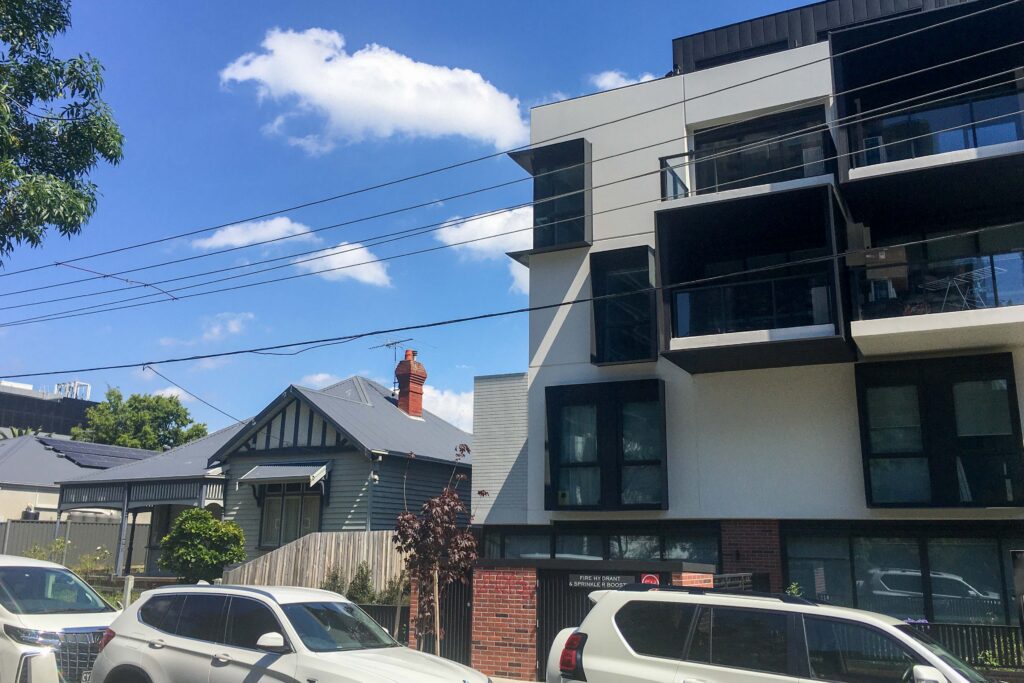
They introduce extensive redevelopment within surrounding low-rise residential neighbourhoods through large walkable catchments, substantial residential upzoning, new code-based planning controls, reduced local decision-making and the removal of many residents’ rights.
Community concern is therefore not simply about activity centres themselves. It is about the broader planning model that has been adopted and the extent to which redevelopment now extends into established residential neighbourhoods.
Where is the evidence?
Every major planning model reflects different priorities and involves different trade-offs. For planning changes of this scale, Victorians should be able to understand why one planning model was chosen over other credible alternatives.
The Government has provided little public evidence explaining why this planning model was chosen.
The lack of transparency extends beyond the assessment of alternatives. The Victorian Government has declined to release much of the advice, modelling and evidence used to determine where activity centres should be located, how their boundaries were drawn and why particular building heights were selected.
It has also refused to release infrastructure modelling and related reports that informed these decisions (see Concerns → Can infrastructure keep pace?).
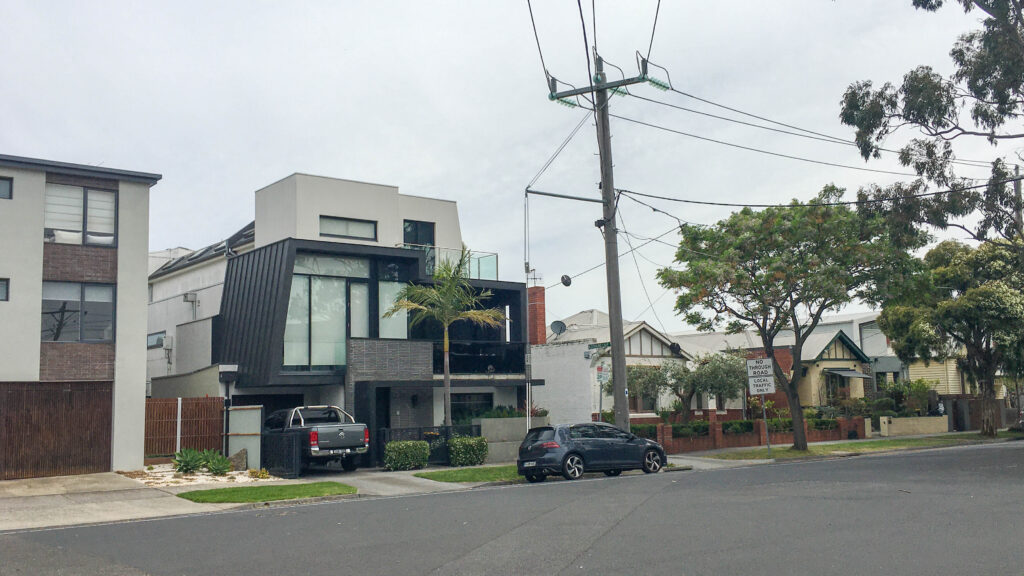
The planning changes place significant emphasis on increasing housing capacity and streamlining development approvals. Little information has been provided about how impacts on neighbourhood character, tree canopy, biodiversity, infrastructure capacity, public open space and liveability were weighed in the decision-making process, or how these impacts are expected to be managed over time.
Without access to this information, Victorians are simply being asked to trust that the Government chose the best planning model.
Victorians cannot know whether different approaches may deliver additional housing while achieving better environmental, social and community outcomes, or whether many of the concerns discussed throughout this website — including impacts on neighbourhood character, heritage, tree canopy, infrastructure and local decision-making — might have been reduced, avoided or better managed if given more priority.
Bayside Council has commenced Supreme Court proceedings seeking access to some of these documents, highlighting the significant public interest in greater transparency. For planning reforms that will reshape Melbourne for generations, Victorians should not have to rely on court proceedings to understand the evidence behind decisions that will permanently change their communities.
What this means for Melbourne
Decisions about how Melbourne grows will shape the city for generations. Once established neighbourhoods are substantially redeveloped, those changes are effectively permanent.
The Government’s planning changes extend well beyond traditional activity centre planning.
They introduce widespread residential upzoning throughout the middle-ring suburbs and new code-based planning controls that will influence neighbourhood character, private gardens, tree canopy, infrastructure, public open space and the everyday experience of living in many communities.
The question is not whether Melbourne should grow. It is how that growth should be planned and why this planning model was chosen over other credible alternatives.
Victorians deserve more than claims that the planning changes will create “vibrant” communities. Victorians should be able to see the evidence, understand the trade-offs and have confidence that major planning decisions have been made transparently after genuinely considering the available alternatives.
Explore related topics
These planning issues are closely connected. You may also be interested in:
- Government Plans
Overview of the Activity Centres Program, planning Codes and related planning changes. - Concerns → Is planning the barrier?
Is planning really the main barrier to solving Victoria’s housing shortage? - Concerns → Affordable housing
Will market-led redevelopment deliver genuinely affordable housing? - Concerns → Community consultation and engagement
Were communities and councils given a genuine say before decisions were made? - Resources → Independent expert analysis
Independent reports and expert analysis on planning alternatives.